War and Rumours of Wars - The Middle East Connection.

Updated: Apr 19
Wars Are the Beginning, Not the End
When we take a moment to step back and observe the growing tensions across the Middle East—conflicts involving Israel and Gaza, the rising pressure surrounding Iran, the lingering instability in Syria, and the quiet but steady shifting of alliances throughout the region—it becomes very easy to treat these events as though they belong to another world entirely, distant both in geography and in consequence. The headlines appear, the updates cycle through, and life continues on, often without much reflection on what any of it might truly mean beyond the surface. Many believe this is just the nature of man, yet another conflict, and eventually it will pass, so that the world will continue as it always has. Yet the Scriptures invite us to look again, and to look more carefully.
Christ Himself spoke of such times, not in vague or uncertain language, but with a clarity that seems almost unsettling when placed alongside the present moment:
“And ye shall hear of wars and rumours of wars… see that ye be not troubled: for all these things must come to pass, but the end is not yet.” — Matthew 24:6
There is something deeply important in that final phrase—the end is not yet—because it challenges a common assumption. War feels final. Conflict feels decisive. The scale and intensity of global unrest can give the impression that history is reaching its breaking point. And yet, according to Christ, these things are not the conclusion of the story. They are not the final chapter. They are, in fact, the opening movements of something far greater that is still unfolding and this shifts the perspective entirely.
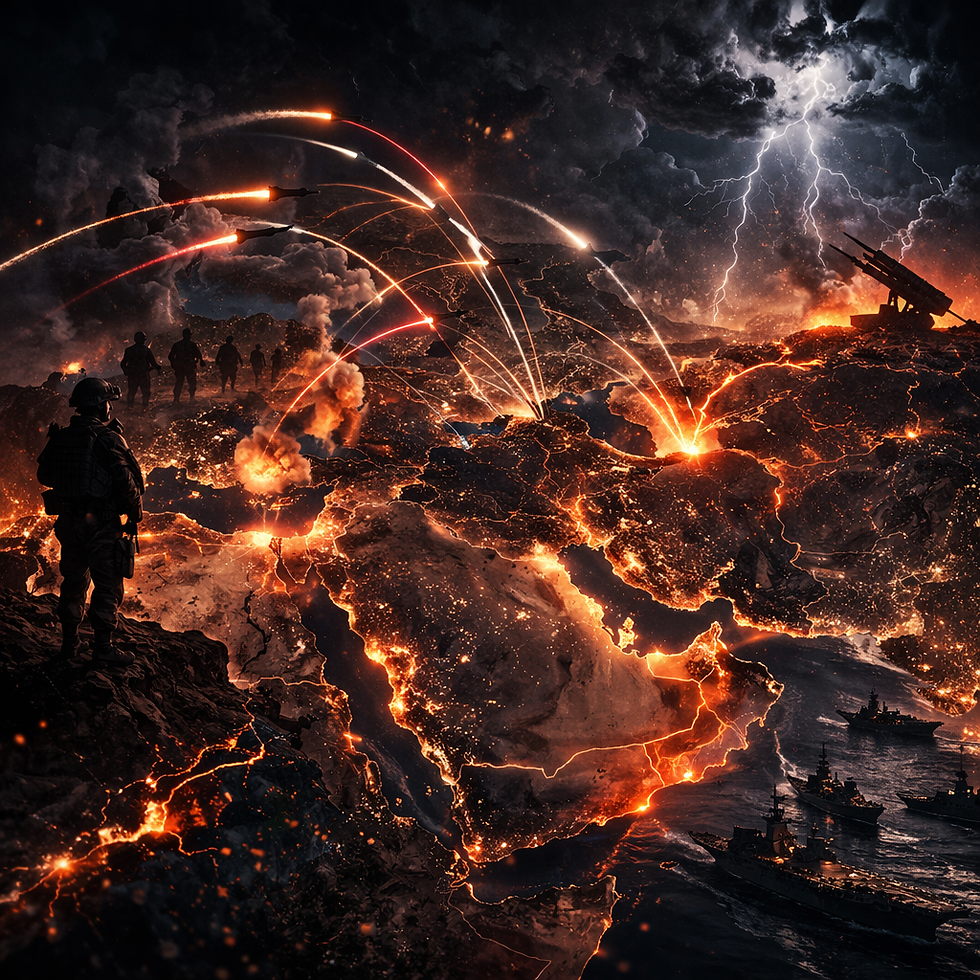
Because, if wars are not the end, then they must serve a purpose beyond themselves. They are no longer just events to be observed, analysed, or even feared in isolation. Instead, they become part of a larger progression—one that moves beyond battlefields and into the structure of the world itself.
History quietly confirms this pattern for those willing to notice it, as conflict rarely ends when the fighting stops. It reaches further, reshaping borders, redefining alliances, unsettling economies, and placing pressure on systems that once appeared stable and secure. What begins as military confrontation often becomes political transformation, and what begins in one region can ripple outward until its effects are felt across the globe. But even this is only part of the picture.
Because beyond the visible consequences lies something deeper—something that prophecy draws our attention toward. Scripture does not focus solely on who wins or loses in these conflicts. It does not dwell on the strategies of nations or the outcomes of individual battles. Instead, it reveals what such events begin to do within the human condition itself.
Conflict unsettles the heart as much as it does the world. It introduces uncertainty where there was once confidence. It exposes weaknesses in structures that were once trusted without question. It creates a quiet but growing awareness that the systems people rely upon may not be as secure as they once believed. And in that space—where stability begins to fracture—something else begins to emerge.
A searching. A desire for resolution. A willingness, sometimes subtle and sometimes urgent, to accept solutions that promise peace, order, and a return to stability. This is not a new development, nor is it unique to our time. It is a pattern that has repeated itself across generations, unfolding in different forms yet always producing similar outcomes. And according to the prophetic word, it is a pattern that will not fade but will instead intensify as history moves toward its closing moments. Which brings us back to the present.
The conflicts we see today may appear political, regional, or even temporary when viewed through a purely human lens. Yet when placed alongside the words of Scripture, they begin to take on a different significance—one that reaches beyond immediate circumstances and into the unfolding of a much larger narrative. And so, the question gently but persistently rises to the surface:
If these things are not the end…if they are only the beginning… Then what, exactly, are they preparing the world to receive?
Crisis and Control: A Pattern Repeated
If we follow that question honestly—without rushing past it or softening its implications—it begins to open a line of thought that history itself quietly confirms. There is a pattern that has repeated across generations, often unnoticed in the moment, yet unmistakable when viewed in hindsight. Moments of crisis rarely remain contained within themselves.
They tend to become turning points.
It has long been observed, in different ways and from many voices across history, that upheaval creates opportunity, and that moments of instability often give rise to forms of order that would not otherwise emerge. The phrase “order out of chaos,” widely associated with the Scottish Rite and reflected in the writings of Albert Pike, captures this idea with striking simplicity, while the familiar expression that one should “never waste a crisis,” often attributed in modern form to Winston Churchill, echoes the same underlying principle in more contemporary language. These words are not drawn from Scripture, yet they reflect something that human systems have consistently demonstrated, because when structures are shaken, when uncertainty begins to spread, and when stability no longer feels secure, the conditions are created for change that would otherwise be resisted.
Under ordinary circumstances, people hold tightly to what is familiar. Systems that appear stable are rarely questioned, and authority is seldom expanded without hesitation. But when crisis enters—whether through war, economic strain, or global uncertainty—the atmosphere begins to shift. What once seemed unnecessary can begin to feel essential. What once appeared extreme can begin to look reasonable. And what would have been rejected in times of peace can be accepted in the name of restoring order.
This is not speculation. It is a pattern that has unfolded repeatedly across history.
Empires have risen out of instability. Governments have extended their reach in times of fear. Financial systems have been reshaped in the aftermath of collapse. Again and again, disruption has given way to restructuring, and restructuring has given rise to new forms of authority designed to stabilise what has been shaken.
Some have even pointed to the 1871 letter attributed to Albert Pike, written to Giuseppe Mazzini, suggesting that global conflicts may unfold according to long-term strategic designs. While such claims may seem historically unverified and should not be treated as strictly authoritative, they reflect a broader reality: human systems often pursue influence and control across generations, working toward outcomes that extend far beyond a single moment of crisis.
And yet, even this observation, grounded as it is in history, only begins to touch the surface of what Scripture reveals. Because the Bible does not merely describe isolated cycles of crisis and recovery. It points forward to something far more comprehensive—a time when the world is drawn toward a unified system, not only politically, but economically and religiously as well. What history demonstrates in fragments, prophecy reveals in fullness. What begins as external disruption gradually moves inward with the need for stability becoming a desire for unity.

That desire for unity begins to shape systems of authority and those systems, once established, begin to define what is acceptable, what is permitted, and ultimately, what is to be followed. It is here that the pattern takes on a deeper significance. Because the movement from crisis to control is not, in the prophetic sense, an end in itself. It is a transition. It prepares the ground for something more comprehensive—something that does not merely restore order, but seeks to unify it under a single, global framework of influence.
Yet the Bible does not rely on hidden documents or human speculation to explain where this is leading. It has already revealed, with clarity and consistency, the rise and fall of powers and the final alignment of the world. And that raises a question that is far more searching than the first:
When the world begins to move from chaos toward order…what kind of order is it being led into?
To answer that, we need to step beyond observation and into prophecy—because Scripture does not leave this question unanswered.
The Prophetic Framework: Woes and Warring Powers
So, to understand where this movement is leading, we must step beyond observation and into the structure that Scripture itself provides, because the Bible does not leave the rise and fall of nations, nor the unfolding of global events, to uncertainty, but reveals a framework that stretches across history with remarkable consistency, bringing the present moment into clearer focus when it is allowed to speak for itself.
When the prophecies of Daniel and Revelation are considered together, rather than in isolation, a pattern begins to emerge—not fragmented, not disjointed, but continuous—moving through time with purpose, revealing how powers rise, how they contend, and how, ultimately, they give way to something far more unified than what came before.
Within this unfolding, the book of Revelation introduces three distinct “woes,” each marking a deepening phase of turmoil, not as random calamities detached from history, but as stages within a larger movement—each permitted within limits, each contributing to the shaping of what follows, and each standing as an outward expression of a deeper spiritual conflict and each hindering Gods people.
The first and second woes, when viewed through the lens of history, are closely associated with forces that arose in opposition to established religious systems, particularly in regions where the influence of Christianity had spread, their impact being significant yet largely regional in scope, centred in the Middle East, where they disrupted, restrained, and in many ways slowed the outward expansion of what had once been a dominant religious influence, yet even in their intensity, they remained contained within defined boundaries.
But the third woe does not simply continue what has come before; it carries the pattern forward into something far broader, something no longer confined to regions or restrained within the limits that once defined earlier movements, though still deeply connected to the same geographic origins. Where the earlier phases of conflict unfolded within particular territories and influenced specific areas of religious and political life, this final phase widens until its reach is no longer localised, but global, touching not only nations and systems, but the very inner convictions of those who live within them, as the conflict that was once contained begins to extend its consequences across the whole world.
In the earlier periods, disruption could be seen, measured, and, in some sense, contained. It affected the spread of influence, altered the balance of power, and slowed what once appeared unstoppable, yet it remained largely external in its impact. But as the prophetic narrative moves forward, that external disruption gives way to something more penetrating, something that reaches beyond structures and into the realm of belief itself, where questions of allegiance, authority, and worship are no longer theoretical, but deeply personal.
It is at this point that the scale of the prophecy becomes unmistakable, because as the Scriptures unfold, they reveal a consistent principle in which what begins in limited form is later expanded to its full and final expression, so that what was once revealed in partial form widens until it becomes universal in scope, and what once operated externally presses inward, shaping not only the world that surrounds us, but the convictions that quietly govern the heart.
And it is here, in this widening of scope, that the prophetic line recorded in Daniel begins to run alongside the movement described in Revelation, not as a separate account, but as a parallel unfolding that brings added clarity to what is taking place. In the eleventh chapter, two opposing forces are traced across time—the King of the North and the King of the South—locked in a long and shifting conflict that reflects more than simple territorial ambition, because though their historical expressions change, the principles they embody remain consistent.
One represents the open rejection of divine authority, where human reasoning, materialism, and self-determination are elevated in the place of God, forming systems that resist His authority not quietly, but directly. The other represents a power that professes allegiance to God, yet moves to unite authority, influence, and control in a way that extends beyond faith itself and into the governance of belief and practice, seeking not only to guide, but to define.
These are not fixed identities bound to a single nation or era, but enduring principles that have appeared in different forms throughout history, expressed through ideologies, institutions, and movements that reflect either resistance to God’s authority or the attempt to assume it.
And as the prophecy moves toward its final scenes, these opposing forces do not simply fade into the background, nor do they remain locked in endless stalemate, but instead their conflict intensifies and begins to give way to something more decisive, as the struggle moves beyond competition and begins to push into dominance, revealing that what is unfolding is not merely a contest of nations, but the outward expression of a deeper spiritual divide, not opposing sides as one might first imagine, but two expressions of the same underlying movement, both working, in different ways, toward the weakening of the bond between God and His people.
Because the conflict traced through these prophetic lines is not simply between belief and unbelief in its broadest sense, but between two defining principles—on one side, a system that sets aside the authority of God altogether, and on the other, a system that professes to uphold Him while moving to establish a form of authority that stands in His place—and it is written:
“And at the time of the end shall the king of the south push at him: and the king of the north shall come against him like a whirlwind…” — Daniel 11:40
And so, as the prophetic narrative advances, these principles do not remain in balance, and the tension between them does not continue indefinitely, but begins to resolve, as what was once divided starts to gather, and what once stood in opposition gives way to a more concentrated form of influence, revealing that where resistance cannot prevail from without, it gives way to a more subtle movement from within, where deception accomplishes what opposition could not.
As this movement continues, the scattered nature of conflict does not remain as it once was, but begins, almost imperceptibly at first, to narrow, as the many competing voices that once defined the landscape gradually lose their independence, giving way to a condition in which influence is no longer dispersed, but drawn together, concentrated, and increasingly unified.
And when this progression is considered alongside the unfolding of the woes, the pattern becomes difficult to ignore, because what was once revealed as disruption within limits now advances into something far less contained, where the effects are no longer confined to particular regions or systems, but extend outward until the outcome is no longer ongoing division, but a movement toward alignment, and with that alignment comes a profound shift in the nature of the conflict itself, as the many forces that once appeared divided begin to give way to a condition in which influence is no longer shared, but gathered.
No longer is it defined by the interaction of many powers, each contending for position and influence across a fragmented world, but instead it begins to centre upon a single point of authority, and with that shift comes a question that carries far greater weight than any that have arisen before, because when authority is no longer dispersed but gathered, and when the world is no longer divided but brought into a form of unity, the issue is no longer who is contending, but who is being followed.
And so the movement that began with unrest, that deepened through conflict, and that widened through consequences no longer confined to any one region, now draws steadily toward a point where its direction can no longer be misunderstood or ignored, as what was once scattered begins to gather, what once appeared uncertain begins to take shape, and what once seemed like isolated events reveals itself as part of a progression moving toward a single, defining outcome.

When the earlier phases of prophecy are seen in their proper place, they reveal how history has been permitted to unfold within limits, allowing powers to rise, to act, and then to give way in accordance with a purpose greater than themselves, but as that unfolding reaches its final phase, the focus shifts from what has been to what is now forming, and from what has been allowed to happen to what is being brought into place.
It is within this transition that the weight of the moment becomes unmistakable, because the world does not remain suspended in conflict indefinitely, and the turbulence that once defined it begins, slowly but with increasing clarity, to settle into structure, while the instability that once fractured it gives way to a form of order that promises resolution, even as it quietly establishes control.
And as this movement carries forward—from unrest to structure, from division to consolidation, from conflict to a stabilised form of unity—the nature of the question itself begins to change, no longer centred on which power will rise or fall, nor on how the conflicts will play out across the visible stage of history, but on something far more direct, far more searching, and far more personal.
Because when the dust of conflict begins to settle, and when the systems that emerge from it begin to define the shape of the world that follows, the issue is no longer one of observation, but of response, for what stands at the centre of that emerging order will not remain neutral, and what it requires will not remain optional. And so the question that remains is not distant, and it is not abstract, but presses itself quietly, yet firmly, upon every life that must exist within that order:
What authority will stand at the centre…and what will it require of those who remain?
From Conflict to Alignment: The World Reorders
When the principles of prophecy are allowed to unfold in this way—moving from what is partial to what is complete, from what is external to what presses inward—the present moment begins to take on a different kind of clarity, as events that might otherwise appear disconnected begin to reveal a pattern, and patterns that once seemed distant begin to feel uncomfortably close.
The conflicts that continue to unfold across the Middle East—whether in Israel and Gaza, in the tensions surrounding Iran, in the instability that lingers within Syria, or in the broader shifts of alliance that ripple through the region—are often understood through the lens of politics, territory, and long-standing disputes, and while these explanations account for much of what is seen on the surface, they do not fully explain why such events carry consequences that extend far beyond their immediate boundaries.
Because these conflicts do not remain contained, but move outward, shaping economies, influencing global markets, and drawing distant nations into their orbit through alliances, dependencies, and shared concerns, until what began as regional tension begins to affect the structure of the wider world itself, and as the ripple effects are felt in rising costs, shifting diplomatic positions, and increasing uncertainty, a deeper realisation begins to take hold—that stability, once assumed, is no longer guaranteed.
And as that sense of instability deepens, something else begins to take form alongside it—not abruptly, and not always visibly, but steadily, and with increasing momentum, as the pressures created by disruption give rise to a growing need for coordination, not imposed in a single moment, but emerging through necessity, shaped not by one voice alone, but by many responding to the same conditions.
Agreements begin to form where division once stood, and alignments begin to shift where independence once prevailed, while conversations that once seemed unlikely begin to take place with a growing sense of urgency, as the recognition settles in that the challenges facing the world are no longer local in nature, but require responses that extend beyond the boundaries of any single nation.
When viewed in this light, the present movement toward coordination is not without precedent, because recent history itself records repeated attempts to bring the world into forms of unity, often rising out of periods of instability and driven by the desire to establish lasting order.
From the sweeping expansions of Genghis Khan, to the efforts of Charlemagne to unite large portions of Europe under a combined political and religious structure, to the campaigns of Napoleon Bonaparte, and later the ideological reach of Germany, each represents a moment in which fragmentation gave way to consolidation, yet each ultimately fell short of achieving lasting global unity.
And yet, for all their differences in origin and structure, these movements continue to follow a familiar pattern, one that has appeared throughout history in varying forms, where the path toward unity does not always begin with agreement, but often with disruption, as moments of overwhelming force—what in more recent language has been described as “shock and awe”—create conditions in which existing structures are destabilised, resistance is weakened, and the ground is prepared for what follows.
But while such methods may initiate change, they rarely sustain it, because what is established through force alone cannot endure without acceptance, and so the pattern does not end in disruption, but moves beyond it, as the aftermath of instability gives rise to systems designed to restore order—structures that are not imposed in a single moment, but introduced gradually, adopted incrementally, and eventually depended upon as necessary.
What distinguishes the present moment, however, is not merely the presence of this pattern, but the scale and nature of the systems now taking shape, no longer driven by individual empires alone, but by interconnected structures that extend across nations and operate through cooperation as much as through influence.

Structures such as the European Union demonstrate how multiple nations can operate within shared frameworks, while alliances such as NATO reflect increasing levels of coordinated security and strategic alignment, and global forums such as the World Economic Forum bring together political, economic, and corporate leadership in ways that increasingly centre on collective responses to global challenges, while proposals such as those associated with the Club of Rome explore the organisation of the world into regional frameworks as a means of managing complexity on a global scale.
Alongside these visible structures, the emergence of a truly global economy has bound nations together in ways that previous generations could scarcely have imagined, where markets, supply chains, and financial systems are no longer confined within borders, but operate as part of an interdependent network in which disruption in one region can reverberate across the entire world, and within this framework, international groupings such as the G20 bring together the world’s major economies to coordinate responses to financial instability, reinforcing a system in which cooperation is no longer optional, but necessary.
Within such a world, a recognisable principle begins to emerge—one that has been observed across history in different forms, and often expressed in phrases such as “order out of chaos,” or the more modern sentiment to “never waste a crisis,” not as declarations of certainty, but as reflections of a pattern in which moments of instability create the conditions through which new structures can arise and take hold.
It is for this reason that some have suggested that events may follow patterns similar to those attributed to Albert Pike, in which global conflict unfolds in stages according to long-term designs, contributing to broader shifts in the structure of the world that follows. In more recent years, similar themes have appeared within global forums such as the World Economic Forum, where discussions surrounding economic reset, shared systems, and the future of global cooperation reflect an increasing movement toward collective frameworks that extend beyond national boundaries.
And yet, even this perspective, grounded as it is in human reasoning, only begins to touch the surface of what Scripture reveals, because the Bible does not rely on hidden documents or speculative theories to describe the future, but speaks plainly of a time when the world moves toward alignment, when influence becomes centralised, when economic structures carry authority, and when the systems that govern society extend beyond politics alone and into the realm of belief and allegiance.
As this movement continues to unfold, the nature of influence itself begins to change, no longer expressed primarily through force, but through agreement, through systems that are adopted rather than imposed, and through structures that become so embedded within daily life that they are no longer questioned, but depended upon.
In the same way, control is no longer established solely through conquest, but through systems that guide behaviour, shape participation, and establish the boundaries within which individuals and nations must operate, until what emerges is not simply the resolution of conflict, but the formation of a united structure capable of directing the course of the world that follows.
And as those systems take shape—formed out of necessity, strengthened through cooperation, and accepted as the means of restoring order—they do more than stabilise the world; they begin to define it, setting the terms of what is acceptable, determining what is required, and establishing what must ultimately be followed.
It is at this point, when alignment begins to replace division and when structure rises from instability, that the prophetic picture presses beyond the visible world and into the life of the individual, because the conflict that remains is no longer measured by borders or influence alone, but by something far more personal. For what is being formed is not simply a system of order… but a system that carries expectation.
And it is from this point—where the world begins to move from conflict toward coordinated structure—that the question naturally turns forward, not only to what is forming, but to how such a movement may yet unfold, and what paths may lead from the present moment into the final conditions described in prophecy.
Watching the Direction: What Might Yet Unfold
As we draw together what has been outlined, it becomes clear that the purpose has not been to predict events, but to better understand where humanity now stands within the unfolding stream of prophetic time, because once even a faint sense of that position begins to form, the mind cannot help but turn forward, considering what may yet lie ahead and how the present moment might give way to what Scripture has already described.
What follows, then, is not a declaration of certainty, nor a claim to insight beyond what has been revealed, but a careful consideration of how the conditions now visible within the world could develop in ways that align with the prophetic picture set forth in the Word of God, recognising that prophecy is not given for speculation, nor for confident human interpretation, but is most clearly understood as it is fulfilled, confirmed through the steady unfolding of history rather than the assumptions of those who attempt to define it in advance.
And yet, while the exact sequence of events is not laid out in full detail, the nature of the outcome is described with remarkable clarity, and it is from that clarity that certain expectations begin to emerge, not as predictions, but as patterns that may reasonably be anticipated if the direction of prophecy is allowed to speak for itself.
Christ Himself spoke of a world marked by increasing unrest, where “nation shall rise against nation, and kingdom against kingdom” (Matthew 24:7), not as an end in itself, but as the beginning of conditions that would prepare the way for what follows, because the prophetic narrative does not conclude in chaos, but moves through it toward a form of alignment that becomes increasingly visible as events unfold.
This is seen with even greater clarity in the book of Revelation, where a power is described whose influence extends across the whole world, so that “all the world wondered after the beast” (Revelation 13:3), and again, that it “causeth all, both small and great, rich and poor, free and bond, to receive a mark” (Revelation 13:16), language that does not describe a divided or fragmented humanity, but one brought into a condition of remarkable unity—one that is not only political in nature, but extends into economic participation and personal compliance, for it is further written that “no man might buy or sell, save he that had the mark” (Revelation 13:17).
If such a condition is to exist, then it follows that the systems capable of sustaining it must also come into place, not suddenly, and not without resistance, but gradually, through the pressures of instability, the demands of coordination, and the growing recognition that fragmented responses are no longer sufficient for a world that has become deeply interconnected.
From this perspective, it becomes possible to consider how present developments might contribute to such an outcome, not as fixed predictions, but as pathways that align with the direction already revealed, particularly in light of the tensions that continue to unfold across the Middle East, where the involvement of regional and global powers has already begun to extend the consequences of conflict far beyond its point of origin.
And within these unfolding possibilities, a more defined consideration begins to take shape, not as a fixed prediction, but as a narrowing of direction, because if the prophetic picture reveals a world in which resistance to unified authority is ultimately overcome, then the question is not whether such a transition will occur, but how the present conditions may give rise to it.
At the centre of this consideration stands a reality that is difficult to overlook, because in the present world order, the United States holds a position of influence that extends across military strength, economic reach, and cultural presence in a way unmatched by any other nation, and it is this position that places it, whether by intention or by circumstance, at the heart of how global responses are shaped in times of crisis.
One possible pathway, then, may unfold through the continued escalation of external conflict, where tensions already visible across the Middle East draw in wider participation, placing increasing strain upon global stability until the need for resolution gives rise to stronger alliances, deeper coordination, and the consolidation of authority in ways that extend beyond the battlefield itself. In such a progression, the role of the United States becomes increasingly central, not only in influencing the outcome of conflict, but in shaping the structures that follow, as resistance is gradually brought into submission and alignment begins to take form under systems that carry both authority and expectation.

Yet another pathway may unfold not through external dominance alone, but through internal pressure, where the economic and social consequences of conflict begin to reverberate within the United States itself, or other nations at the same time, producing strain that unsettles their internal stability and raises questions about the sustainability of the systems upon which much of the global order depends. In such a movement, disruption within a nation of such influence does not remain contained, but extends outward, creating conditions in which restructuring becomes necessary, not only domestically, but across the broader network of nations that are tied to its economic and strategic reach.
And while these pathways appear distinct—one in which the United States moves as a central force in shaping global alignment, and another in which it becomes a pressure point through which wider instability unfolds—they are not opposing outcomes, but converging movements, because both lead toward the same prophetic condition, one in which the forces that resist alignment do not remain indefinitely, but are brought, whether gradually or decisively, into a position where unified authority is no longer resisted, but established.
When these possibilities are considered alongside the direction already revealed in Scripture, a further realisation begins to emerge, not as a fixed conclusion, but as a quiet recognition, because if the final movements of prophecy point toward a world in which resistance is ultimately overcome and authority becomes unified, then the developments now unfolding are not without significance, but may well represent the kinds of conditions through which that outcome is brought into place.
And if that is so, then what is being witnessed in the present moment may not stand in isolation, but may form part of a broader movement that leads, whether through conflict or through collapse, toward the same defining result, suggesting not a single predetermined path, but a narrowing of possibilities in which the direction remains constant, even where the details may differ.
For Scripture does not present the final conflict as one fought solely between nations, nor as a struggle defined by territory or power alone, but as one that ultimately centres upon worship itself, for it is written that “all that dwell upon the earth shall worship him” (Revelation 13:8), revealing that what emerges from this process of alignment is not merely a system of governance, but a system that carries expectation, one that does not simply organise the world, but seeks to define what is to be followed within it.
Because the path may vary, but the destination has already been revealed, and as the world continues to move—whether through conflict or through collapse, through strength or through restructuring—the question that remains is not which outcome will prevail, but whether we recognise where it is leading, and what it will ultimately require.
And if that direction is becoming clearer, if the patterns now unfolding are not as uncertain as they once seemed, then the question can no longer remain at a distance, nor can it remain theoretical, because what is forming will not simply shape the world around us, but will press upon the life of each individual in ways that cannot be ignored.
For the movement we are witnessing is not one that ends in observation alone, nor one that remains confined to systems and structures, but one that carries with it a weight that settles quietly, yet unmistakably, upon the individual, calling not only for awareness and consideration, but for a readiness that can no longer be set aside.
Because if the system now taking shape carries expectation, then the question is no longer what it is, but how it will be lived under, and how those who find themselves within it will respond when that expectation is no longer distant, but present.
And it is here, at this point of quiet recognition, that the next step begins to take shape, not as an attempt to define what has not yet fully unfolded, but as a careful examination of how such a system may operate in practice, and what it may require of those who must live within its reach.
Because the Scriptures do not leave this movement without an end, nor do they present a world that continues indefinitely within its own systems, but point instead to a moment when the course of history reaches its appointed conclusion, and the One who has spoken these things brings them to their fulfilment, not as uncertainty, but as certainty, for “heaven and earth shall pass away, but my words shall not pass away” (Matthew 24:35).
And if that is so—if what has been spoken cannot fail, and if what has been revealed must come to pass—then the question is not whether these things will unfold, but when the conditions now forming will reach their fullness, and how the world, and those within it, will stand when that moment arrives.
And if that moment is drawing nearer, then the time for grounding ourselves in the truth of God’s Word, as revealed in the Holy Scriptures, cannot remain something set aside, because what is formed in quiet moments of preparation will be what remains when pressure is no longer distant, but present.


Comments