War and Rumour of War: Spiritual Conflict Explained

There are moments in history when the world does not shift suddenly, but seems instead to move under a growing weight, as though something unseen is pressing upon it from every side. Conflict rises, tensions spread, and what was once distant begins to feel near, until the language of war is no longer confined to isolated events, but becomes part of the atmosphere in which daily life unfolds.
Across regions once separated by distance and circumstance, a pattern begins to emerge—not always clearly defined, not always fully understood, yet persistent enough that it cannot be easily dismissed. What was once considered exceptional begins to feel familiar, and what was once unexpected begins to take on the character of something anticipated, as though the world itself is settling into a rhythm that carries its own momentum.
And in such a moment, where events accumulate and patterns form, there is a quiet invitation—not to react, nor to conclude too quickly, but to consider whether what is being witnessed is as self-contained as it appears, or whether it belongs to something not yet fully seen.
The Language of Wars and Rumours
It would be a rare thing indeed for any person living in this present hour to remain untouched by the steady stream of reports that now flow across the world, for whether by word of mouth or by the constant pulse of information that surrounds modern life, the conflicts that trouble distant lands have been brought near, until even those who stand far removed from the places themselves feel, in some measure, the weight of what is unfolding. The tensions in the Middle East, the prolonged struggle between Russia and Ukraine, and the quiet but persistent unrest that seems to rise in many regions at once, have become familiar not only as events, but as conditions—something no longer exceptional, but expected, as though the world itself has settled into a pattern that cannot be easily broken.
And yet, for all that is seen and spoken of, there remains an assumption so deeply rooted that it is rarely brought into question, namely, that war belongs entirely to the realm of human action, that it begins with the decisions of nations, is shaped by the ambitions of leaders, and finds its meaning within the visible movements of armies and the shifting boundaries of power. It is considered a product of circumstance, an outcome of competing interests, a consequence of human nature expressed on a larger stage. But such an understanding, though widely accepted, rests upon a foundation that has not been carefully examined, for it assumes that what is seen is also what is primary, and that what is measured outwardly contains within itself the full explanation of its existence.

Yet there is reason to pause before accepting such a conclusion too readily, for if the pattern of conflict were truly self-contained within the sphere of human affairs, one might expect that, given time, knowledge, and advancement, it would diminish, or at least take on a different character. Instead, what is observed is not the fading of conflict, but its persistence, not its resolution, but its repetition, as though it belongs not merely to the actions of men, but to a deeper current that continues to move beneath them, shaping outcomes in ways that are not always immediately understood.
It is here that the words once spoken by Christ begin to take on a significance that reaches beyond their surface meaning, for when He declared that there would be wars and rumours of wars, He did not speak of a single event, nor did He describe a final moment toward which all things would abruptly move, but rather He revealed a condition that would continue, a pattern that would unfold across time, not as the end itself, but as part of a larger unfolding. And within those same words, there is a caution that seems at first to stand in tension with the reality they describe, for alongside the acknowledgement of conflict comes the instruction that those who hear of such things are not to be troubled, not because the events lack importance, but because they do not, in themselves, constitute the conclusion.
Such a statement invites a reconsideration of what is being observed, for if these things are not the end, then they cannot be the source, and if they are not the source, then their meaning must lie beyond themselves. A sign, by its very nature, directs attention elsewhere; it points away from what is immediately visible toward something that has not yet been fully revealed. And yet, it is often at this very point that understanding falters, for the tendency is to remain fixed upon what can be seen, to analyse the visible while overlooking the possibility that the visible is not the origin, but the expression of something already in motion.
For it has ever been the case that what appears outwardly is not always where a matter begins, and that which manifests in visible form is often the result of influences that have long been at work beneath the surface. Conflict, as it is known among men, does not arise in a moment, nor does it emerge without cause, yet the causes most commonly identified—power, territory, ideology—though real in their place, do not fully account for the persistence, the recurrence, and the peculiar consistency with which conflict reappears across generations, as though it belongs to a pattern that precedes the individuals who take part in it.
It is therefore not unreasonable to consider that what is now witnessed upon the earth may not be the beginning of war, but rather its continuation, that the struggles which define human history may, in fact, be the visible outworking of something that did not originate within humanity at all. For before the first man drew breath, before the earth was filled with the activity of nations and the rise and fall of kingdoms, there was already, within the order of creation, a disturbance—subtle at first, not marked by outward conflict, yet possessing within it the seeds of division.
It did not begin with violence, nor with any form that could be easily observed, but with a turning of thought, a movement away from trust, a questioning of what had once been accepted without hesitation. In a realm where harmony had never been broken, where every being moved in accordance with the will of God, such a deviation, however small it may have appeared at its inception, could not remain without consequence, for that which departs from truth does not remain contained; it extends, it influences, and in time, it seeks expression.
Thus, what began as dissatisfaction did not remain hidden, but grew in reach and in voice, until that which had once been unthinkable began to appear reasonable, not by compulsion, but by persuasion, not by force, but by the subtle distortion of what was true. And in this way, the first conflict was formed—not as it is now seen among men, but in a manner far more profound, for it was a conflict over the very nature of authority, the character of God, and the foundation upon which trust itself rests.
The Scriptures speak of this plainly, declaring that there was war in heaven, a statement that, though simple in its expression, carries within it a depth that cannot be lightly considered, for it reveals that conflict, in its earliest form, did not arise from human weakness, but from a rebellion that preceded humanity altogether. And when that rebellion reached its full expression, when the division could no longer remain concealed, there was no reconciliation through compromise, but a separation, a casting out of those who had chosen to oppose the order of heaven.
And the celestial beings that once lived in heaven were cast to the earth. Not into some distant and unreachable realm, but to this world, which would become the appointed place where the consequences of that rebellion would unfold. Here, within the boundaries of human existence, the conflict would continue, not in the same form in which it began, but in a way that would draw humanity itself into its course.
Which is why, when war later appeared among men, it did not arrive as something entirely new, but as the visible continuation of something already set in motion, something that had entered the sphere of human life long before humanity itself had begun to understand the nature of the struggle. For the same principle that once found place in the heart of a created being in heaven—a turning from trust, a desire for self-exaltation, a quiet resistance to the authority of God—did not remain confined to that first rebellion, but, having gained entrance into this world, found expression again within the hearts of men, where it continued its work unseen, shaping thought before it shaped action, and forming intent before it revealed itself in deed.
And so the conflict, though outwardly expressed in the movements of nations and the rise of violence among peoples, is not born in the field where it is fought, but in the inner workings of the heart, where pride gives way to distortion, and distortion gives way to division, until that which began as unseen dissatisfaction brings forth visible consequence. In this way, what is observed as war is not the origin of the struggle, but its manifestation, the outward form of an inward condition that has been present from the beginning, working quietly, persistently, and with increasing boldness as it moves toward its full expression.
And so the words remain, not merely as a description of events, but as a key to their meaning, for wars and rumours of wars are not self-explaining phenomena, but signs—indicators of a reality that lies beyond what is seen, pointing back to a conflict that did not begin on earth, yet now unfolds within it, not only around man, but within him, shaping the course of history in ways that cannot be fully understood until their origin is rightly considered.
And if this is so, then the question is no longer simply why wars occur, nor even how they may be resolved, but rather what they reveal, and what lies beneath them, waiting to be understood by those willing to look beyond the surface of what is seen, and to consider whether the true battlefield has always been closer than it appears.
The Veil Lifted: A World Unseen
If it is true that the conflict now unfolding upon the earth did not begin within it, and if what is seen outwardly is but the continuation of something already set in motion, then it must also be true that the world as it appears to human sight is not the full measure of reality, but only a part of it, a visible layer resting upon a structure that extends beyond what the natural eye can perceive. For it would be unreasonable to suppose that effects so consistent, so enduring, and so deeply rooted in the experience of every generation could arise without a cause that lies beyond the surface in which they are expressed.
The Scriptures do not leave this to speculation, but speak of a creation far more expansive than what is immediately observed, declaring that all things were brought into being not only in the realm that is seen, but also in that which remains unseen, both existing by the same Word, sustained by the same power, and ordered according to the same divine purpose (Colossians 1:16). This alone is enough to unsettle the common assumption that reality is confined to the physical, for it reveals that what is visible does not stand alone but is accompanied at all times by a realm that, though hidden from human perception, is no less real in its presence or its activity.
Within this unseen order are beings whose existence does not depend upon flesh, whose movement is not confined by the limitations that govern human life, and whose purpose is not self-directed, but given. They are described as ministers, sent forth with intention, acting not independently, but in harmony with the will of God, their work often unnoticed, yet continually unfolding in ways that intersect with the lives of men (Hebrews 1:14). Their obedience is not reluctant, nor is it compelled, but arises from a clear understanding of the authority under which they serve, moving with strength and precision as they carry out that which has been spoken (Psalm 103:20).
This is not the language of myth, nor the shaping of imagination, but the testimony of Scripture concerning a reality that operates alongside the world of men, though rarely acknowledged by it. For while humanity measures its existence by what can be seen, there is an ongoing movement beyond that perception, one that does not interrupt the natural order, but works within and around it, often without recognition.
And within that order there is structure, not confusion; there is rank, not disorder; there is nearness to the presence of God, and there is movement outward from that presence, not as wandering, but as commission. The Scriptures speak of beings who stand in proximity to the throne, of others who move as messengers, and of a host that responds in unity to the command of God, revealing a kingdom not of instability, but of perfect arrangement, where every part is known, and every function is fulfilled without conflict (Daniel 7:10).
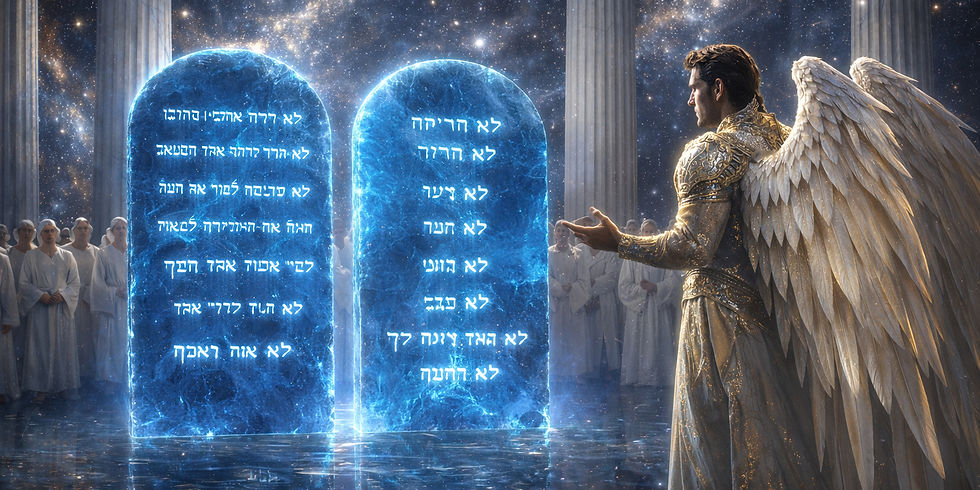
Such a state, once established, was not fragile, nor was it sustained by force, but by the willing harmony of those who existed within it. Truth was not contested, nor was the character of God misunderstood, for there was no reason within that order to question the One from whom all life proceeded. The peace of that realm was not the absence of activity, but the presence of alignment, where every created being moved in accordance with the will of God, not as servants bound by constraint, but as participants in a reality defined by trust.
And yet, it was within this very order that something began to take shape, not outwardly at first, but inwardly, as a deviation that could not be measured by action alone. For the introduction of distrust into a realm built upon trust is not a small disturbance, but a fracture at the deepest level of existence, one that does not remain contained, but extends, influencing thought before it manifests in action.
The Scriptures reveal that this unseen world is not inactive in relation to the earth, but deeply connected to it, for there are those who move between the presence of God and the affairs of men, observing, acting, and responding within the boundaries appointed to them, while others, having departed from that order, continue their movement within this world with an entirely different purpose (Job 1:7). This interaction is not occasional, nor is it peripheral, but constant, though seldom recognised, for the influence of the unseen does not always announce itself in ways that can be easily identified.
It is here that the understanding begins to deepen, for if such a realm exists, and if within it both loyalty and rebellion have already been established, then the world of men cannot be considered separate from it but must be understood as existing within its reach. What unfolds upon the earth is therefore not independent, but connected, not isolated, but influenced, not self-originating, but responsive to forces that extend beyond what is immediately perceived.
And so, the veil, though still present, begins to thin—not by the revealing of something new, but by the recognition of something that has always been there, hidden not because it does not exist, but because it is not sought. For what is unseen is not absent, and what is hidden is not inactive, and until this is understood, the events of the world will continue to be interpreted as though they stand alone, when in truth they are part of a greater whole.
And if this is so, then the question is no longer simply what is happening upon the earth, but what is moving within its boundaries, what is influencing it, and what lies just beyond the limits of human perception, shaping outcomes in ways that cannot be fully explained by what is seen alone.
The First War
If the unseen realm is one of order, harmony, and purposeful design, then the introduction of conflict within it cannot be understood as a natural development, nor as something arising from deficiency in its creation, but must instead be traced to a departure from that which was originally established as good. For the Scriptures declare that all things were made by God and that His works were complete, lacking nothing, sustained in perfection according to His will (Genesis 1:31), and therefore the origin of disruption cannot be found in the design itself, but in a deviation from it.
Within that order there existed one who was not only created, but exalted in position, entrusted with responsibility, and placed in proximity to the very presence of God. He is described as perfect in his ways from the day he was created, full of wisdom, and adorned with beauty beyond measure, established in a role that reflected both honour and trust (Ezekiel 28:12–15). There was nothing lacking in what had been given to him, nor any limitation placed upon him that would justify dissatisfaction, for his standing was not one of restriction, but of privilege.
Within that position there was not merely honour, but responsibility, for he stood not at a distance, but near to the very presence of God, in a role that reflected the order and government of heaven itself. The law of God, which is the foundation of that order, was not hidden from him, nor was the character it expresses unknown, for he moved continually in its light, bearing witness to its harmony, its justice, and its goodness. Even in the pattern later shown upon the earth, where the throne of God was represented and overshadowed by cherubim, there is a reflection of that nearness, a testimony that those who stand closest to the presence of God do so not in isolation, but as part of a structure that upholds His government and reveals His ways (Exodus 25:18–20; Hebrews 8:5). In this way, what had been entrusted to him was not simply proximity, but understanding, not merely position, but participation in the revelation of God’s character to the created host.
And yet, it is here that the Scriptures reveal something that cannot be explained by circumstance alone, for iniquity was found in him, not imposed, not created by another, but arising from within (Ezekiel 28:15). This is the beginning of what cannot be fully measured, the emergence of a principle that does not originate in outward condition, but in inward disposition, where the freedom given to a created being becomes the ground upon which a choice is made, not toward trust, but away from it.

For it is written that his heart was lifted up because of his beauty, and his wisdom was corrupted by reason of his brightness (Ezekiel 28:17), revealing that what had been given as a reflection of God’s glory became, in his own estimation, a ground for self-exaltation. What was meant to direct attention upward began instead to turn inward, and in that turning, the foundation of harmony was quietly displaced.
This was not yet war as it would later be seen, but it was the seed from which war would grow, for once the authority of God is questioned, and once the position of the created being is elevated above that which was assigned, the order that sustains peace can no longer remain intact. The Scriptures further reveal the expression of this inward change, for it is written that he said in his heart, “I will ascend… I will exalt my throne… I will be like the Most High” (Isaiah 14:13–14), not as a statement spoken outwardly at first, but as a resolve formed within, where desire takes shape before action follows.
And in this way, the mystery deepens, for what began as inward corruption did not remain confined, but sought expression, and expression, in time, becomes influence. The Scriptures speak of his tail drawing a third part of the stars of heaven, casting them down with him (Revelation 12:4), revealing that this was not a solitary departure, but a persuasion that extended beyond himself, reaching others not by force, but by the same distortion that had first taken root within him.
Thus the conflict took form—not as a clash of strength, but as a division over truth; not as an immediate destruction, but as a separation that arose from competing claims. For if God’s authority could be questioned, then allegiance itself became divided, and where division exists within a kingdom, conflict is no longer avoidable.
And so the Scriptures declare that there was war in heaven (Revelation 12:7), not as the beginning of disorder within God’s rule, but as the necessary outcome of a rebellion that had fully revealed itself. The conflict, though described in terms that suggest confrontation, must be understood in light of what preceded it, for it was not born in violence, but in deception, and it was not sustained by power alone, but by the choice of those who aligned themselves with that deception.
Yet even here, the sovereignty of God remains unchanged, for the outcome is not uncertain, nor is the authority of heaven diminished. The one who sought to ascend was cast down, and those who followed him were removed with him, not into a place of continued influence within heaven, but to the earth, where the conflict would take on a new form within the sphere of human existence (Revelation 12:9).
This moment does not mark the end of the conflict, but its transition, for what began in the unseen now enters the seen, and what was once confined to the realm of heavenly beings is brought into the experience of humanity. The same principles remain—trust and distrust, truth and distortion, submission and self-exaltation—but they now operate within a different setting, one in which the consequences will be observed in ways that cannot be ignored.
And so the first war, though fought in heaven, does not remain there, for its effects are carried forward, not as a distant memory, but as an active influence, moving now within the boundaries of this world, where the unseen continues to shape the seen, and where the origin of all conflict remains present, though rarely recognised.
For the issue at its core has never changed, and until it is resolved, the expression of it will continue, appearing in different forms, across different ages, yet always rooted in the same departure from truth that first gave it life.
Earth Becomes the Battlefield
If the rebellion that arose in heaven had fully revealed itself, and if those who chose to oppose the authority of God had been cast out from His presence, then a question remains that cannot be easily dismissed, for it reaches beyond the outcome of the conflict and into the character of the One who presides over it. Why was it permitted to continue at all? For if the power of God is without limit, and if His authority cannot be overthrown, then the rebellion might have been brought to an immediate end, its influence removed, its origin extinguished before it could extend beyond its first expression. And yet, this was not done.

The one who had departed was not destroyed, nor were those who followed him brought to a sudden end, but instead were removed from the courts of heaven and allowed to continue, not within that realm where harmony must remain unbroken, but within another sphere, where the consequences of what had begun might unfold. This is not the action of weakness, nor the result of uncertainty, but the outworking of a purpose that cannot be understood apart from the nature of the rebellion itself, for that which had arisen was not merely opposition, but deception, and deception, if silenced without being revealed, leaves behind questions that cannot be answered and doubts that cannot be resolved.
For had the rebellion been brought to an immediate end, before its nature had been fully revealed, the question it raised would not have been answered, but silenced, and that which was hidden within it might have remained misunderstood. Authority upheld by power alone, though unquestioned in its outcome, does not of itself produce understanding, nor does it establish trust where doubt has already been introduced. The issue at stake was not whether God could overcome opposition, but whether His character would be known as it truly is, and whether the path of departure would be seen, not as an alternative, but as a distortion that leads away from life. It was therefore necessary that what had begun in secret be brought into the open, not to sustain rebellion, but to expose it, so that no place might remain for uncertainty, and no foundation be left upon which distrust could again take root (Revelation 15:3; 1 John 1:5).
It is within this purpose that the creation of humanity must be understood, not as an isolated act, nor as an afterthought, but as part of a wider unfolding in which the principles at the heart of the conflict would be made visible in a form that could not be dismissed. For when the earth was formed, it was declared good, not only in its structure, but in its purpose, established as a place where life would exist in harmony with the will of God, and where the relationship between Creator and created would be expressed without distortion (Genesis 1:31).
Humanity was brought into existence not with a knowledge of rebellion, but in innocence, created in the image of God, capable of understanding, capable of choice, and placed within an environment that reflected the order and goodness of heaven itself (Genesis 1:27). Nothing within that setting compelled disobedience, nor was there any necessity that would lead toward deviation, for all that was needed for life and for communion with God had already been provided.
And yet, within that same environment, there was one element that carried within it the possibility of departure, not as a flaw, but as a condition of freedom, for the command given concerning the tree of the knowledge of good and evil established a boundary, not to restrict, but to define the relationship between trust and obedience (Genesis 2:16–17). For without the possibility of choice, there can be no genuine allegiance, and without the presence of an alternative, trust cannot be tested.
It is here that the conflict, having been removed from heaven, enters fully into the experience of humanity, not by force, but by approach, for the one who had first introduced deception now appears again, not in his original form, but in a manner suited to the setting in which he now moves, speaking not openly of rebellion, but subtly, through question and suggestion, seeking to accomplish in humanity what had already taken root within himself (Genesis 3:1).
The method does not change. What had once been a turning of thought away from trust is now repeated, as the question is raised, not with accusation, but with implication, drawing attention away from what God has said and toward what might be gained apart from it. “Has God indeed said…?” is not merely a question of words, but of authority, for it introduces doubt where there had been certainty, and in doing so, it opens the way for distortion to take hold.

And when the word of God is set aside, even momentarily, the ground shifts, for the source of truth is no longer the foundation upon which the decision is made. What follows is not immediate destruction, but a change in perception, where that which was forbidden begins to appear desirable, and that which was clear becomes subject to reinterpretation (Genesis 3:6).
Thus the same principle that brought about the first rebellion finds expression again, not imposed from without, but accepted from within, as trust gives way to self-determination, and obedience is replaced with choice apart from the will of God. And in that moment, the conflict that had been external becomes internal, no longer confined to the presence of a deceiver, but established within the human heart.
From that point forward, the consequences unfold with a consistency that reflects their origin, for separation from God brings not only spiritual division, but also the conditions under which fear, struggle, and conflict begin to arise among men (Genesis 3:16–19).
What had once been harmony becomes tension, what had once been unity becomes division, and what had once been life without corruption begins to move toward decay.
And so the earth, which had been created as a place of harmony, becomes the arena in which the conflict continues, not merely through the presence of the one who deceives, but through the response of those who choose whether to trust or to depart from that trust. Humanity does not stand outside the conflict, but within it, not as passive observers, but as participants, whose choices reflect the same principles that first gave rise to the rebellion.
This is why the unfolding of history cannot be understood apart from the condition of the human heart, for what appears outwardly in the form of division among nations is rooted in the same departure from truth that now exists within individuals. The desire for control, the pursuit of power, the willingness to elevate self above others—these are not separate from the original rebellion, but are its continuation, expressed in forms that reflect the setting in which they occur (James 4:1–2).
For the outworking of that which began in rebellion does not continue without result, nor does it unfold without revealing the nature of that from which it proceeds, for sin, which is the transgression of the law, carries within itself a consequence that is not imposed from without, but arises from what it is, separating the created being from the Source of life and leading, in its final expression, to death (1 John 3:4; Romans 6:23). This is not merely a condition observed among men, but a testimony that extends beyond them, for the unfolding of this conflict has not been hidden from the wider creation, but has been set forth in such a way that its principles might be seen and understood, not only on earth, but by those who look on from beyond it (1 Corinthians 4:9).
And yet, even in this, there is restraint, for the continuation of sin has not been left without limit, nor has the suffering it produces been permitted to extend without end, for the same authority that allowed the rebellion to unfold has also appointed its conclusion, setting a boundary beyond which it cannot pass, so that what is now revealed in part will in time be brought to its full and final end (Nahum 1:9). In this way, both the nature of rebellion and the justice of God are made known together, not in contradiction, but in harmony, for while sin is allowed to reveal itself, it is not granted dominion without end, and while its consequences are real, they are not eternal in their reign.
And so the battlefield is not only the world, but the heart within each person, and the conflict is not only between nations, but between trust and distrust, between truth and distortion, between the will of God and the will of His created beings.
For what began in heaven has not ceased, but has been allowed to unfold, that its nature might be fully revealed, and that every created being, whether in heaven or on earth, might see clearly the difference between that which proceeds from God and that which arises in opposition to Him.
And in this way, the question is no longer distant, nor confined to the events of history, but brought near, into the life of every individual, for the same choice remains, unchanged in its essence, though varied in its expression.
Whether to trust… or to depart.
The Final Movements: When the Unseen Becomes Seen
If the conflict that began in heaven has continued upon the earth, and if its principles have worked quietly within the human heart across generations, then it follows that its final expression will not remain hidden, nor will it continue indefinitely in the same restrained form in which it has long operated. For that which has been unfolding gradually does not remain incomplete, but moves toward a point at which its nature is more fully revealed, not in part, but with increasing clarity, so that what was once subtle becomes evident, and what was once concealed begins to appear openly.
The Scriptures speak of such a time, not as a departure from what has already been, but as the intensification of it, where deception, having long worked beneath the surface, begins to manifest in ways that cannot be easily dismissed. It is written that there would arise a working of power, with signs and lying wonders, not as isolated occurrences, but as part of a broader movement designed to persuade, to mislead, and to draw the attention of men away from that which is true (2 Thessalonians 2:9). This is not the introduction of something new, but the unveiling of what has long been present, now expressed more openly as the conflict approaches its appointed conclusion.
For the one who first introduced deception has not ceased in his purpose, nor has he altered his method, but continues to work through distortion, presenting that which is false in a form that appears true, and that which opposes God in a manner that resembles Him. It is therefore no small thing that the Scriptures declare that even Satan himself is transformed into an angel of light, for this reveals that the final movements of the conflict will not be marked primarily by open opposition, but by imitation, where the appearance of truth is used to conceal the absence of it (2 Corinthians 11:14).

And if this is so, then the danger does not lie merely in that which is openly contrary, but in that which closely resembles what is right, yet departs from it in its foundation. For deception is most effective when it does not appear as deception, but as an extension of what is already accepted, gradually shifting understanding until that which was once clear becomes uncertain, and that which was once rejected becomes embraced.
It is within this context that the increasing interest in the supernatural must be considered, not as an isolated cultural development, but as part of a wider movement in which the boundaries between what is seen and what is unseen begin to appear less defined. The world, having long looked for explanations within itself, now turns outward, seeking contact, seeking guidance, seeking assurance that there exists a reality beyond what is immediately known.
But, this turning is not without direction, for it does not arise in a vacuum, but within the unfolding of a conflict that has long been working beneath the surface, now moving toward a more open expression, where that which was once concealed begins to appear with greater clarity, and the influence of the unseen becomes less easily dismissed. In this way, what was once regarded as distant, uncertain, or even imagined, begins to take form within the experience of men, not as the arrival of something new, but as the revealing of what has long been present, now permitted to manifest more openly as the conflict approaches its appointed conclusion (Revelation 16:14; 2 Thessalonians 2:9).
And yet, the Scriptures have never left this question unanswered. For they declare that there are indeed beings who move beyond the limitations of human perception, not bound to flesh as man is, and not confined in the same manner, yet active within this world, not as distant observers, but as participants within the ongoing conflict. The question, therefore, is not whether such beings exist, but who they are, and by what authority they act.
For it is also written that the dead know not anything, that their thoughts have perished, and that they have no further portion in anything done under the sun (Ecclesiastes 9:5–6), establishing clearly that those who have died do not return to communicate with the living. And yet, there are manifestations that claim otherwise, voices that appear familiar, presences that seem known, offering comfort, guidance, and assurance that contradicts the plain testimony of Scripture.
This is not a contradiction within the Word of God, but the continuation of the same deception, for if those who have departed cannot return, then those who appear in their likeness must be something else, presenting themselves in a form designed to be received without question, appealing not to reason grounded in truth, but to emotion, memory, and a trust that has been subtly displaced from its proper foundation.
In the same way, the expectation of contact with beings beyond this world, often framed as discovery or advancement, must be considered in light of what has already been revealed, for while the idea of intelligence beyond humanity is not foreign to Scripture, the origin and nature of such beings are not left undefined, being neither distant nor uninvolved, but part of the very conflict that has been unfolding from the beginning, now operating within this world, though not of it.
What, then, may appear to many as something new, something unexplained, or even something hopeful, is in truth the final expression of something far older, now brought into clearer view, not to enlighten, but to persuade, continuing the same purpose that has marked the rebellion from its beginning, which is to draw the mind away from truth, to reshape understanding through subtle distortion, and to replace trust in God with confidence in that which merely appears convincing.
And it is here that the words of Scripture take on their full weight, for the final movements are not described as a time of simple confusion, but as a time of strong delusion, in which those who have not received the love of the truth are given over to believe that which is false, not because truth was unavailable, but because it was not received (2 Thessalonians 2:10–11), so that what unfolds is not arbitrary, but the natural result of a choice long forming beneath the surface.
For throughout the unfolding of the conflict, the same principle has remained unchanged, that truth must be received, not merely acknowledged, and that the Word of God must be trusted, not merely heard, for where that trust is absent, the foundation upon which discernment rests is weakened, and in its place, that which appears convincing is accepted without examination, until the distinction between what is true and what merely resembles truth is no longer easily discerned.
And so the conflict, which began in heaven, and which has worked within the world and within the heart of man, now reaches a point where its two paths stand clearly defined, not hidden beneath layers of subtlety, but presented in forms that demand recognition, not between what is obviously good and what is obviously evil, but between truth itself and that which bears its likeness while departing from its source.
Conclusion — The Quiet Decision
If what has been set before us is true, as the Word of God claims it is, if the conflict that began beyond the sight of man has continued through every age and now moves toward a more open expression, then the question that remains is no longer distant, nor theoretical, but immediate and personal, for it concerns not only the unfolding of events within the world, but the position of the individual within them.
For it has been shown that deception does not merely oppose truth, but imitates it, and that its greatest strength lies not in what is openly false, but in what appears convincing, what resonates with what has already been accepted, and what aligns itself with the expectations that have quietly been formed within the mind. And if this is so, then the final movements of the conflict will not meet a world unprepared, but one already conditioned, one already familiar with the ideas through which deception may be received without resistance.
It is therefore not unreasonable to understand that what is to come will not stand apart from what has been, but will draw upon it, using the language, the imagery, and the expectations that have long been established, so that when the moment arrives, it will not appear foreign, but fitting, not unexpected, but timely, as though it answers the very need that has been building beneath the surface.
And yet, it is here that the danger becomes most pronounced, for when the boundaries between what is seen and what is unseen are no longer clearly distinguished, and when the pressures of the world—conflict, instability, and uncertainty—bear heavily upon the mind, the desire for resolution becomes urgent, and the willingness to accept what appears to provide it becomes greater. In such a setting, the senses themselves cannot be relied upon as a final measure, for what is seen may persuade, and what is heard may convince, yet neither can establish truth where its foundation has not first been laid.
For the Scriptures have already declared that there would arise manifestations of power, of signs, and of wonders, not as evidence of truth, but as instruments of deception, designed to lead astray those who have not anchored themselves in that which does not change (2 Thessalonians 2:9). And if this is so, then the question is not whether such things will occur, but how they will be discerned when they do.

For if a voice speaks with authority, yet departs from the Word of God, it cannot be trusted. If a presence appears with power, yet contradicts what has been revealed, it cannot be received. If that which claims to bring light leads away from truth, then it bears not the mark of God, but of the one who imitates Him.
It is therefore not by sight, nor by sound, nor by feeling that the final distinction is made, but by the Word of God alone, for it remains the only foundation that does not shift, the only measure that does not change, and the only light that is not subject to imitation (Isaiah 8:20).
And this is why the call, though simple, carries such weight, for it is not a call to observe more, nor to analyse more, but to return—to return to that which has been given, to search it, to understand it, and to settle into it before the moment of testing comes, for when that moment arrives, it will not introduce a new choice, but will reveal the one that has already been made.
For the conflict, though vast in its scope, is decided in the smallest of places—in the quiet alignment of the heart with that which is true, or with that which merely appears to be so.
And when all else is stripped away—when voices rise, when signs appear, when the world itself seems to move toward a resolution that promises peace yet departs from truth—only that which has been grounded in the Word will remain unmoved.
This, then, is why these things have been set forth—not to alarm, nor to speculate, but to reveal, so that what is approaching may be recognised for what it is, and that those who would stand may do so, not by strength of their own, but by trust in that which cannot fail. For the end of the conflict will come, not in uncertainty, but in fulfilment, and when it does, the difference between what is true and what only appeared to be so will no longer be hidden.
And so, the question is no longer distant, nor reserved for another time, but present, and quietly pressing upon the heart—whether that which has been revealed will be received as truth and trusted now, or set aside until the moment when it must be tested.


Comments