War and Rumours of Wars
- Adonai Katsir

- Mar 16
- 17 min read
A reflection on global unrest, its connection to prophecy, and the nearing close of human history.
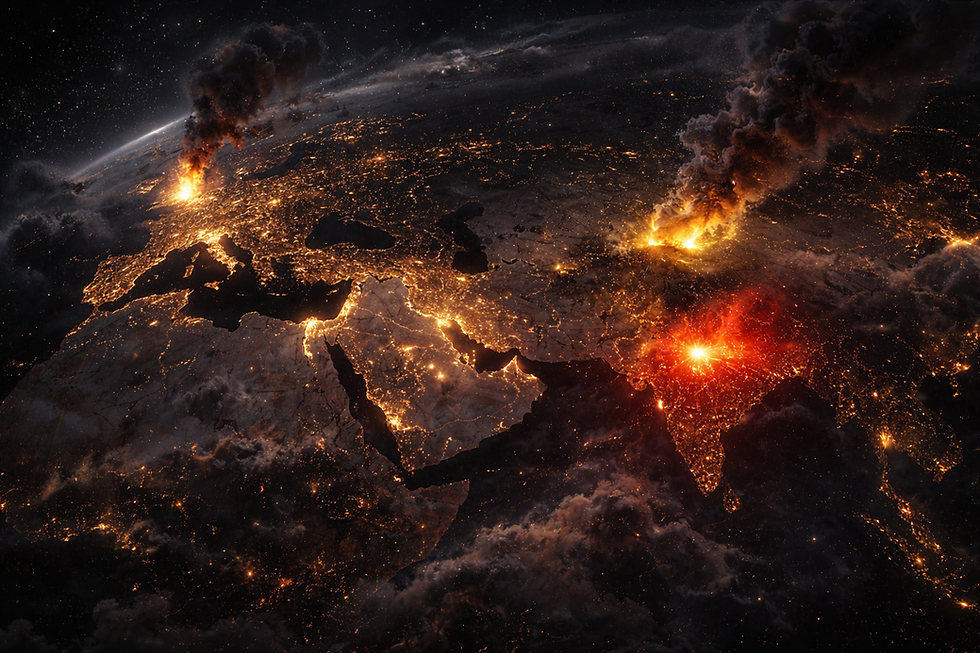
Once again we find the news filled with headlines of war. Turn on almost any broadcast, open any news site, or scroll through the day’s events and the same pattern appears—conflict rising in one region, tensions escalating in another, warnings of military retaliation somewhere else. What once felt like isolated crises now seems to form a continuous backdrop to global affairs.

Over roughly the last four years in particular, the hostility among nations appears to have intensified. Long-standing rivalries have sharpened. Diplomatic language has grown increasingly strained. Military movements that once occurred quietly behind the scenes are now openly discussed in public statements and strategic briefings. Alliances shift, defence spending expands, and regions that had maintained a fragile calm for decades suddenly return to the headlines as flashpoints of international tension. The tone of international conversation has noticeably changed, and many observers sense that the atmosphere of global relations is becoming more unsettled.
Yet when we step back and consider the broader sweep of history since the end of the Second World War, the modern era has often been described as a time of uneasy stability. The emergence of powerful nations and global institutions created a delicate balance across the world stage. While tensions between major powers never fully disappeared, that balance helped prevent another conflict on the scale of the two devastating world wars of the twentieth century. But beneath that fragile stability, war has never truly disappeared.
In almost every decade since that time, the world has hosted numerous armed conflicts taking place across different regions. Some burn intensely for a short period before fading from attention, while others simmer quietly for years. In any given year analysts tracking global violence identify dozens of active conflicts around the world—many of them rarely receiving sustained international coverage.
Today the world’s attention is drawn toward several major conflicts dominating global headlines. The war between Russia and Ukraine continues to reshape the political landscape of Europe and remains the largest armed conflict on that continent since the end of the Second World War. Whilst across the Middle East, the war between Israel and Hamas has drawn international involvement and raised fears of wider regional escalation. At the same time, tensions involving Iran, Israel, and the United States have increased the possibility that the region’s conflict could expand beyond its current borders.
Yet beyond these highly visible wars, many other conflicts continue across the world—from the devastating civil war in Sudan, to prolonged violence in parts of Africa, to internal conflicts across regions of Asia and the Middle East. Though they receive far less global attention, these struggles continue to affect millions of lives. Which naturally leads to a sobering question.
If humanity has witnessed the devastation of war so many times throughout history, why does the world continually return to the same pattern? And why does the use of force remain such a common response when tensions rise between nations?
From a purely human perspective, the explanations seem straightforward. Nations compete for resources, defend borders, pursue strategic advantage, or respond to ideological differences. Political ambitions, economic pressures, and historical grievances all contribute to the conflicts we see unfolding across the world. Yet when we move beyond human logic, philosophy or understanding, we find that Scripture invites us to look deeper.
For many people these events feel sudden and alarming, as though the world has entered an unexpected season of turmoil. Yet the Scriptures long ago described a time when such conditions would increasingly characterize the closing chapters of earth’s history. One of the clearest places this appears is when Jesus outlines the future in Matthew chapter 24. Here we see, when Christ’s disciples asked Him about the signs that would precede His return, His answer included a warning that remains strikingly relevant today.
“And ye shall hear of wars and rumours of wars: see that ye be not troubled: for all these things must come to pass, but the end is not yet.” — Matthew 24:6
Christ did not point to a single conflict as the sign of the end. Instead, He described a global atmosphere of unrest—a world in which conflict becomes a recurring and growing feature of human society. Throughout the ages in the span of history these things have always existed, but the modern era also reflects this description with remarkable clarity. Even when one conflict fades from the headlines, another quickly rises in a different region. Peace agreements are signed, yet tensions remain beneath the surface. But even in a world where situations have always existed, these current developments invite thoughtful reflection, for are they simply the normal cycles of history, or are they part of a larger prophetic picture revealing that humanity is approaching the closing moments of its long story?
The Roots of Conflict in a Fallen World
The question naturally arises when we observe the repeated pattern of conflict across human history. Are wars simply the inevitable cycles of political rivalry and national ambition, or is something deeper driving the turmoil we see across the world? Well, Scripture does not leave this question unanswered.
While political analysts often explain wars in terms of economics, territory, ideology, or strategic advantage, the Bible points to a far deeper source behind human conflict. According to Scripture, the struggles between nations ultimately grow out of the same spiritual condition that affects every human heart. That condition is clearly seen in the book of James, where he speaks plainly about this hidden cause:
“From whence come wars and fightings among you? come they not hence, even of your lusts that war in your members?” — James 4:1
Here the Bible reveals something often overlooked in discussions about global conflict. The outward battles that appear between nations are closely connected to the inward struggles taking place within human beings themselves.
Selfishness, pride, ambition, and the desire for power are not merely political forces. They are spiritual conditions that shape the choices of individuals—and those individuals ultimately shape the governments and systems that rule the world. In this way the conflicts between nations often mirror the same struggles that exist within the human heart.
History repeatedly demonstrates this pattern. Nations rise seeking security or influence. Rival powers respond with suspicion. Alliances form, tensions grow, and eventually those tensions erupt into open conflict. When the destruction subsides, treaties are signed and the world attempts once again to restore peace. Yet the deeper problem remains unchanged.

Because the spiritual condition of humanity has not been healed, the cycle begins again.
This is why even the most carefully designed political systems have never been able to eliminate war permanently. Treaties may delay conflict. Diplomacy may calm tensions for a time. International institutions may attempt to regulate disputes. But none of these efforts can remove the selfishness that lies at the root of human behavior.
According to the Bible, this condition began when sin entered the world. When humanity turned away from God’s authority, the harmony that once existed between people began to fracture. The spirit of selfless love that governed creation was replaced by the spirit of self-exaltation. And from that moment forward, conflict followed humanity through every generation.
Yet Scripture reveals that even this was not the true beginning of the conflict, as behind the struggles of humanity lies an even older rebellion—one that began long before human history itself.
The Middle East and the Rising Trouble of the Nations
When we begin to look at the world through the lens of Scripture, the conflicts unfolding around us start to take on a deeper significance. Wars between nations are not merely isolated political events appearing randomly across the map of human history. They often become the points where larger forces begin to converge, drawing together political ambitions, historical grievances, economic pressures, and religious identities in ways that shape the direction of the wider world.
One region where this convergence becomes particularly visible is the Middle East.
For thousands of years this land has stood at the crossroads of civilization. Empires have marched across its deserts, trade routes have connected continents through its cities, and some of the most influential religious traditions in human history have taken root within its borders. Because of this unique position, events in this region rarely remain confined to the local stage. Conflicts that begin here often ripple outward, gradually drawing the attention—and sometimes the direct involvement—of nations far beyond the region itself.
In our own time the Middle East once again sits at the centre of growing global tension. The war between Israel and Hamas has captured the attention of the world and raised deep humanitarian concerns, while the wider involvement of regional powers such as Iran continues to raise the possibility that the conflict could spread further across the region. Strategic alliances, historic rivalries, and religious identities now intersect within a landscape already marked by decades of instability. Yet the significance of these developments may extend beyond the immediate events themselves.
We find the Bible describes a world that, as it approaches the closing chapters of human history, becomes increasingly unsettled. Prophecy portrays a time when the nations experience growing distress, when societies feel the pressure of events moving with unusual momentum, and when the structures that once appeared stable begin to reveal signs of strain. Viewed from this perspective, the conflicts we observe today may be part of a broader pattern of instability gradually spreading across the global stage.
History shows that periods of widespread crisis often reshape the structures of society in ways that few people initially expect. Major wars have repeatedly altered the balance of power between nations, redrawn borders, and transformed economic systems that once appeared permanent. In the aftermath of such upheaval, new institutions are often formed, new alliances emerge, and new frameworks of international cooperation are introduced with the hope of restoring stability to a troubled world.
In times when societies feel uncertain about the future, it is not uncommon for populations to look toward larger systems capable of maintaining order. Political leaders search for ways to preserve stability, protect economic structures, and prevent further collapse, while citizens weary of conflict and disruption often become more open to solutions that promise unity and security on a broader scale. When we reflect on these historical patterns, it becomes easier to understand how periods of global instability can gradually reshape the political and economic structures that govern the world.
Scripture itself speaks of a future time when systems of authority will possess influence reaching far beyond the borders of individual nations. The book of Revelation describes a moment when political and religious power become closely intertwined, and when economic pressure is used as a means of enforcing loyalty to that authority. For such a system to function, the world would already need to be familiar with large-scale coordination of political power, economic regulation, and international cooperation. Societies would need to accept the idea that stability and order sometimes require strong forms of collective authority capable of guiding the direction of the global community.
The intention here is not to suggest that the conflicts unfolding today represent the direct fulfilment of these prophetic descriptions and Scripture does not encourage us to attach every current event to a specific prophetic milestone. Yet it is difficult to overlook the way in which major global crises throughout history have often created the conditions in which new systems of influence and authority begin to take shape. because when viewed through the lens of prophecy, the growing unrest among the nations can therefore serve as a quiet reminder that the structures of the present world are far less permanent than they often appear. The conflicts we see today may not themselves be the final events described in Scripture, but they may well form part of the environment in which those events eventually unfold.
For those who watch the movements of history with the guidance of Scripture, these developments do not necessarily inspire fear so much as thoughtful reflection, reminding us that the world Christ described—a world marked by increasing unrest among the nations—may be gradually moving closer into view.
The Cry for Peace and Safety
As history repeatedly shows, periods of growing unrest among the nations rarely end without producing a profound reaction from the world itself. When conflict spreads, economies strain, and societies begin to feel the pressure of instability, a natural desire emerges within the human heart—a longing for peace, order, and a return to normal life.
This longing is not difficult to understand, because war has a way of disrupting everything it touches.
Communities are displaced, economies weaken, and the daily rhythms that sustain ordinary life begin to fracture. In such moments people instinctively look for leadership capable of restoring stability. Governments search for ways to secure their borders, strengthen alliances, and protect the systems upon which modern societies depend.
Recorded history reveals that these moments often become turning points.
In the aftermath of major conflicts, the structures of the world have frequently been reshaped in significant ways. New international agreements emerge, institutions are created to prevent future wars, and global systems are reorganized in the hope that stability might be preserved. Each generation that has witnessed widespread conflict has also searched for ways to build a world in which such devastation might never occur again. Yet alongside this desire for peace there often appears another pattern.

When societies feel deeply threatened by instability, populations sometimes become more willing to accept stronger systems of authority that promise security and unity. Measures that might once have been resisted in calmer times are often embraced when the alternative appears to be continued chaos. In the face of uncertainty, the desire for order can become powerful enough to reshape both political and social structures.
The Bible anticipated that this impulse toward security would play an important role in the closing chapters of human history.
The apostle Paul wrote of a moment when humanity would believe it had finally achieved stability:
“For when they shall say, Peace and safety; then sudden destruction cometh upon them…” — 1 Thessalonians 5:3
This passage does not suggest that the world will abandon its desire for peace. Rather, it reveals that humanity will continue searching for it, even believing at times that it has been secured. Yet the deeper problems affecting the human condition will remain unresolved.
Throughout history, efforts to establish lasting peace have often involved new forms of cooperation between political power, economic systems, and social influence. Agreements between nations expand, international structures grow stronger, and societies increasingly depend upon systems that operate across national boundaries.
As these systems grow more complex, they also gain greater influence over the daily life of individuals. Economic networks connect nations together, political agreements shape global trade, and international institutions increasingly coordinate responses to crises that no single country can address alone. Seen through the lens of prophecy, this gradual development of interconnected global systems becomes particularly significant.
The book of Revelation describes a time when authority will reach far beyond the borders of individual nations, influencing both allegiance and economic participation on a global scale. The prophetic picture portrays a world in which political power, religious influence, and economic pressure eventually work together in ways capable of shaping the choices of entire populations.
For such a system to emerge, the world would need to be familiar with large-scale cooperation between nations and accustomed to systems capable of coordinating political, economic, and social activity across the globe. Periods of crisis often accelerate exactly this kind of development. When the world becomes unstable, the search for solutions tends to move beyond local or national boundaries. Leaders begin to look for broader frameworks capable of addressing problems that affect entire regions or even the global community. In these moments, ideas that once seemed distant can quickly become practical proposals.
The intention here is not to suggest that the present moment represents the direct fulfilment of these prophetic descriptions, as Scripture does not encourage believers to attach every current event to a specific prophetic milestone. Yet history shows that the greatest transformations of global systems have often followed moments of profound crisis.
When viewed in this light, the growing unrest among the nations may be doing more than simply filling the headlines. It may be gradually shaping the conditions in which humanity becomes increasingly willing to embrace large-scale systems promising peace, stability, and unity. And it is precisely in such an environment that the prophetic warnings of Scripture begin to take on deeper significance.
The Reshaping of World Authority
As mentioned earlier, it becomes increasingly noticeable that when periods of instability begin to shake the foundations of society, history shows that the response of the world is rarely limited to restoring what once existed. Instead, moments of crisis often become the catalysts for far-reaching change. Systems that seemed permanent are reconsidered, alliances are re-examined, and entirely new structures are sometimes proposed in the hope that they might prevent the same turmoil from returning.
The twentieth century offers several clear examples of this pattern. In the aftermath of the First World War, nations sought to prevent another global catastrophe by forming the League of Nations. Though that effort ultimately proved unable to stop the rising tensions that led to the Second World War, it revealed a growing recognition that the problems facing humanity were no longer confined within national borders. When the world emerged from the devastation of the Second World War, that same desire for international cooperation led to the creation of the United Nations, an institution designed to provide a forum where nations could address global challenges together.
Since that time the web of international cooperation has continued to expand. Economic systems have become increasingly interconnected, global trade networks bind nations together in ways unimaginable in earlier centuries, and multinational institutions now play a role in addressing issues ranging from finance and security to environmental concerns and humanitarian crises. In many ways the world has gradually moved toward a level of coordination that previous generations could scarcely have imagined.
Alongside these developments, thinkers in political and economic circles have occasionally explored the possibility that the world may one day require even broader systems of governance in order to manage complex global challenges. Some proposals have suggested organizing nations into larger regional blocs that could cooperate more effectively on economic, environmental, and security concerns. While such ideas remain the subject of debate, they illustrate how the concept of coordinated global authority has already entered mainstream discussion in various forms.
These conversations arise from a practical concern shared by many leaders: the challenges facing humanity today—economic instability, geopolitical tensions, technological disruption, and environmental pressures—often extend far beyond the capacity of any single nation to address alone. As a result, the search for structures capable of managing global complexity has become an increasingly common theme in international dialogue.
When viewed from a purely historical perspective, such developments may simply reflect the natural evolution of political organization in an interconnected world. Yet when these trends are considered alongside the prophetic writings of Scripture, they invite a deeper reflection.
The book of Revelation describes a time when multiple powers will unite in a brief alignment of authority, cooperating in ways that concentrate influence on a global scale. In this prophetic vision, the political forces of the world appear to move together with a shared purpose for a limited period of time.
“And the ten horns which thou sawest are ten kings… which receive power as kings one hour with the beast. These have one mind, and shall give their power and strength unto the beast.” — Revelation 17:12–13
The imagery used in Revelation is symbolic, yet the underlying idea is striking. It portrays a moment in which separate powers act in concert, lending their authority to a larger system for a short but decisive period in history.

Exactly how such a scenario might unfold remains unknown. Scripture does not provide a detailed political blueprint, nor does it encourage believers to attach specific modern institutions to prophetic symbols with certainty. Prophecy often reveals the principles and outcomes of events without explaining every step along the way.
Yet when we consider the direction in which global systems have gradually moved—toward increasing cooperation, expanding international frameworks, and growing interdependence between nations—it becomes easier to imagine how the kind of unified authority described in prophecy could one day emerge.
Moments of widespread crisis have historically accelerated this kind of transformation. When the world faces threats that appear too large for individual nations to resolve alone, the search for broader solutions tends to intensify. In such times, proposals that once seemed ambitious or unlikely can suddenly gain momentum.
The purpose of this reflection is not to suggest that the current global landscape has already reached the point described in Revelation. The prophetic events themselves remain future. Yet the patterns unfolding in the modern world demonstrate that the foundations for such developments are no longer difficult to imagine.
As societies continue to navigate the uncertainties created by conflict, economic strain, and political tension, the search for systems capable of preserving order will likely remain a defining feature of the global conversation. And it is precisely within that search for stability that the prophetic warnings of Scripture begin to carry profound significance, pointing beyond the shifting structures of human authority to a final issue that will ultimately confront the conscience of every individual.
A World Moving Toward Its Final Question
When we step back from the constant stream of headlines and observe the broader movement of history, the turbulence of our present age begins to appear within a much larger context. Wars rise and fall across the landscape of nations, alliances shift as powers reposition themselves, and the structures that once seemed stable occasionally reveal how fragile they truly are. Yet Scripture repeatedly invites us to look beyond the immediate events themselves and consider the deeper story unfolding beneath the surface of world affairs.
The prophetic writings of the Bible reveal that the final chapters of human history will not ultimately be decided by the victories of armies or the ambitions of political systems. While the struggles of nations often dominate the stage of history, the decisive issue described in prophecy reaches far deeper than questions of territory or military strength. Again and again the Scriptures draw our attention to the question of authority—specifically the question of who holds rightful authority over human life and conscience.
Throughout the long narrative of the Bible, this question appears in many forms, yet it always leads back to the same fundamental choice between loyalty to the Creator and allegiance to systems that seek to occupy His place. The book of Revelation portrays a time when this issue becomes impossible to ignore, describing a world in which political power, economic systems, and religious influence intersect in ways that place increasing pressure upon the decisions of individuals. In that prophetic picture, participation in the structures of society itself becomes connected to the question of allegiance, revealing how deeply the final conflict reaches into the everyday lives of humanity.
Seen from this perspective, the unrest that now appears across the nations does not stand alone as the central focus of prophecy. Wars and political tensions form part of the environment in which the larger spiritual conflict continues to unfold, shaping the conditions that will eventually bring humanity face to face with the deeper question of worship and obedience. The turmoil of the present age therefore serves as a reminder that the structures of the modern world are not as permanent as they often appear, and that the shifting movements of nations may be quietly preparing the stage upon which the final events of history will unfold.
For those who observe these developments through the guidance of Scripture, such reflections need not lead to alarm or speculation. The turbulence of our age, though unsettling to witness, does not arrive without warning, nor does it unfold outside the awareness of God. Christ Himself spoke of these very conditions when He warned that the world would hear of “wars and rumours of wars,” and yet in the same breath He offered a counsel that remains deeply relevant for those watching the movements of history today.
Rather than responding with fear, the Scriptures invite a different posture—one marked by thoughtful awareness, compassion for those who suffer in the midst of conflict, and a steady confidence that the larger story of human history remains under divine oversight. Wars bring real pain to countless lives, displacing families and leaving deep wounds across communities and nations. For this reason the proper response of the Christian heart is never indifference, but prayerful concern and practical care for those who find themselves caught in the turmoil of events beyond their control.
At the same time, the Bible encourages us to recognise that the unrest of the nations forms part of a wider movement of history that gradually prepares the world for the closing scenes of the great conflict between truth and deception. Periods of instability often lead societies to search for unity, order, and solutions capable of restoring peace to a troubled world. In that search, new systems of cooperation and authority frequently emerge, drawing nations together in ways that reshape the political and economic structures of the age.
When viewed through the lens of prophecy, these developments suggest that the turmoil of our present world may serve as part of the process through which humanity is gradually drawn toward the final question described in Scripture—the question of whose authority ultimately governs the conscience of mankind.
For the closing conflict portrayed in the prophetic writings of the Bible is not merely a struggle between nations, but a spiritual contest over allegiance itself. It is a moment when the structures of the world press humanity toward a decision, asking each individual where their loyalty ultimately rests.
Yet even within this unfolding story, the Scriptures remind us that the final word does not belong to the turmoil of nations. Beyond the rising tensions of our present age stands the promise that Christ will return, bringing the long conflict of human history to its conclusion and establishing a kingdom that will never again be shaken.
But, until that day arrives, the movements of the world around us serve as quiet reminders that history is moving toward its appointed destination, inviting those who study the Scriptures to look more deeply into the prophetic writings that illuminate how these final events will unfold. In moments such as these, the Scriptures invite us to return to the plain Word of God, where understanding can be found and courage can be strengthened for the days that lie ahead. May the Lord bless all that turn to Him in this moment of conflict, upheaval and confusion.


Comments