From Mish-Mash to Meaning — A Manifesto on Music, Worship, and Discernment in a Deceptive Age.
- Adonai Katsir

- Feb 20
- 19 min read
Why This Body of Work Exists
When all things are said and done, it should be understood that I did not set out to write a manifesto. In truth, I resisted the idea for some time. The first article in this series began with something far less dramatic — just a quiet unease. A growing sense that something felt slightly misaligned between what I was reading in Scripture and what I was hearing in much of the music labelled Christian. It wasn’t that the songs were overtly wrong or intentionally misleading. It was subtler than that. As my understanding of the Bible deepened, my ear began to change.

Music I once accepted without hesitation started to feel thinner in substance. Songs that once stirred emotion no longer seemed to anchor truth in the same way. That unsettled me — not because I wanted to critique anyone else, but because it forced me to ask a more personal question: was I being formed more by familiarity than by Scripture?
Instead of drawing conclusions too quickly, I went back to the Bible. Not to prove a point, but to check whether my unease had any foundation. I began asking simple, honest questions. How does Scripture treat music? What purpose does it serve? What happens when it is rightly used — and what happens when it is not?
The deeper I looked, the harder it became to dismiss what I was seeing. I began to notice that music in Scripture is never incidental. It is never filler or background ambience. When it appears, it carries weight. It reinforces covenant. It expresses repentance. It declares victory. It teaches truth. It warns of danger. It shapes worship. And at times, it even exposes drift.
That discovery shifted the entire conversation for me. This was no longer about preference or style. It was about formation. If music shapes the heart, reinforces belief, and conditions the imagination, then the way we categorise and use it cannot be treated casually. It becomes a matter of spiritual responsibility rather than artistic taste.
On realisation of that point, the question widened beyond my own playlist. If I had sensed this tension, surely others had as well. And if Scripture consistently treats music as formative, then perhaps the issue is not whether something feels “off,” but whether we have quietly lowered our expectations of what music is meant to accomplish in the life of a believer.
That thought cannot be separated from the times in which we live. We are witnessing increasing division — not merely political or cultural, but spiritual. Lines are forming in ways that are not always obvious at first glance. Allegiance is becoming clearer. And worship, though often discussed in sentimental language, sits quietly at the center of it all.
When we study God's Word, we notice that the Bible does not present the final conflict of earth’s history as a clash of personalities or institutions alone. It presents it as a conflict over worship and allegiance — over truth and deception, over who is trusted and who is followed. If that is so, then formation matters deeply. What shapes our affections, what reinforces our understanding of God, and what normalises certain spiritual expectations all carry weight in ways we may not immediately perceive.
Therefore, I believe music, whether we consciously acknowledge it or not, participates in that shaping.
This manifesto was not born out of frustration with artists, instruments, or genres. It emerged from a growing conviction that if Scripture treats music with seriousness, then we must also. If worship ultimately reveals allegiance, then clarity about the purpose of music is not optional.
Before defining anything new, before proposing any framework, and before naming what I believe has been quietly missing, we must return to something older and steadier. We must ask what Scripture actually reveals about music, worship, and formation — and allow that pattern to shape everything that follows.
And that is where this conversation must begin.
Scripture’s View of Music — Formative, Not Neutral
As I continued studying, I began to notice that the pattern I had sensed was not isolated or selective. It was woven consistently through Scripture. Music was never treated as an accessory to faith or as a decorative feature of worship. Whenever it appears, it is attached to something meaningful — covenant, remembrance, repentance, proclamation, or warning.
I noticed that when Israel crossed the Red Sea, they did not merely celebrate their escape. They sang. Their song was not abstract or emotionally vague; it declared who the Lord was, what He had done, and where their loyalty now stood (Exodus 15). The act of singing reinforced theology. It anchored the memory of deliverance in the hearts of a people who would later need to recall what God had accomplished on their behalf. Music, in that moment, became a living testimony — truth carried forward through melody.
It seemed to me that pattern becomes even more explicit in Deuteronomy 31. There, the Lord instructs Moses to write a song and teach it to Israel so that it would serve as a witness among them. The purpose was not entertainment or inspiration alone; it was preservation. When future generations drifted or forgot the covenant, the song would remind them. It would hold truth in memory even when obedience wavered. In this way, music functioned as a theological safeguard, carrying doctrine from one generation to the next.
Then I noticed that the Psalms reflect this same seriousness, as singing is consistently connected with proclamation. “Sing unto the LORD… shew forth his salvation from day to day” (Psalm 96:1–2). The act of singing rehearses redemption. It shapes understanding. It trains the heart to remember who God is and what He has done. Worship is not detached from truth; it reinforces it.
The New Testament continues the pattern without softening it. Paul writes that believers are to speak to one another in “psalms and hymns and spiritual songs,” teaching and admonishing one another as they sing (Colossians 3:16). That language is deliberate. Music is described as instructional. It carries doctrine. It corrects, encourages, and stabilises. What is sung becomes part of what is believed.
I also noticed Scripture that records moments when music exposes spiritual condition. For example, when Moses descended from Sinai, the sound he heard revealed confusion before he even saw the golden calf (Exodus 32). Worship that had detached itself from covenant truth produced noise that reflected inner drift. The music mirrored the state of the heart.
Yet, in another account, David’s playing brought relief to Saul when his spirit was troubled (1 Samuel 16:23). The text does not describe music as spiritually inert. It interacts with the inner life in ways that are real and consequential, and taken together, these passages reveal a consistent principle: music in Scripture forms memory, reinforces belief, influences spiritual atmosphere, and expresses allegiance. It is never framed as neutral ground. It shapes worship, and worship in turn shapes the direction of a people.

That realisation changed the nature of my original unease. I was no longer asking whether certain styles felt shallow. I was asking whether we have quietly underestimated what music does. If what is sung becomes what is remembered, and what is remembered shapes understanding, then music participates directly in spiritual formation.
And if worship reveals allegiance, then the seriousness with which Scripture treats music is no longer surprising. What becomes especially striking, however, is how carefully earlier generations of believers seemed to understand this connection.
So, before examining how that understanding has unfolded through Christian history, it is worth acknowledging that for centuries this connection between music, doctrine, and formation was not debated. It was assumed.
That is where we turn next.
When Clarity Was Normal — From Scripture to Hymns to Reformation
After seeing how consistently Scripture treated music with seriousness, I found myself asking a natural question: had believers throughout history understood it the same way?
If music in the biblical record was formative — shaping memory, reinforcing doctrine, and expressing allegiance — did the church carry that understanding forward?
Turning to history did not require romanticising the past. It required observation.
What becomes clear from early Christian records is that singing was not treated as secondary or ornamental. It functioned as shared confession. The Psalms formed the backbone of worship, providing language that was already saturated with covenant themes — repentance, praise, lament, hope, and trust in the character of God. When believers gathered, they sang Scripture or songs shaped closely by it. The content was not abstract; it was theological.
As the early church faced doctrinal challenges, music continued to serve a clarifying role. Hymns were written not merely to inspire devotion, but to articulate and defend core truths. The divinity of Christ, the reality of the incarnation, the hope of resurrection — these were not left to sermons alone. They were embedded in congregational song. In a world where literacy was limited and written manuscripts were scarce, melody became a vehicle for memory. What could be sung could be retained. What could be retained could be confessed.
This pattern continued through the centuries. Musical styles evolved, and cultural influences were not absent, yet the underlying assumption remained remarkably consistent: what the church sings must align clearly with what the church believes. Music was not categorised primarily by sound or tempo, but by purpose. It reinforced doctrine. It cultivated reverence. It directed attention toward the holiness and sovereignty of God.
The Reformation intensified this intentionality rather than diminishing it. Reformers who sought to restore Scripture to the center of Christian life understood that worship could not remain unchanged. Psalms were translated and set to music in the language of the people so that biblical truth could be internalised by entire congregations. Hymns were composed to teach theological clarity emerging from renewed engagement with Scripture. Singing was not peripheral to reform; it was part of it.
I noticed this was not a rejection of beauty or emotion. Devotional songs that expressed personal reflection and gratitude were present as well. But even these remained anchored in biblical themes — repentance, surrender, grace, redemption. Emotion was not isolated from truth; it was shaped by it, as if feeling flowed from doctrine rather than replacing it.
I believe that it would be inaccurate to suggest that every era handled music perfectly or that disagreements never existed, as musical expression has always interacted with culture to some degree. Yet the historical record shows a consistent expectation that music would serve formation. To sing was to confess. To confess was to align oneself with revealed truth.
For centuries, this integration of Scripture, doctrine, and music was broadly assumed. Worship was not primarily evaluated by its emotional intensity or stylistic appeal, but by its faithfulness to the truth it proclaimed.
And that makes the contrast with our present moment more noticeable. Our own time appears markedly different — and it is to that difference that we must now turn.
The Modern Drift — When Style Replaced Function
In contrast to the historical clarity we have just traced, our present moment appears noticeably different. That realisation prompted me to look more closely at what may have shifted — not to criticise creativity or dismiss modern expression, but to understand how we arrived here. As you may have observed, Christian music today spans an astonishing range of styles and subcultures. Worship anthems fill arenas. Radio-friendly pop blends seamlessly with mainstream production standards. Hip-hop, rock, acoustic, electronic, and ambient forms all carry the Christian label.
On one level, this diversity reflects something positive. Christianity has never existed in a cultural vacuum. Musical expression has always interacted with the sounds, instruments, and artistic language of its time. Cultural influence in itself is not inherently corrupting. The Psalms were written in a cultural context. Reformation hymns reflected the melodic structures of their era. Form evolves, but the question, however, is not whether culture influences music. The question is what governs that influence.
What appears to have shifted in recent decades is not merely the sound of Christian music, but the way it is categorised and evaluated. Increasingly, music is grouped by genre and emotional tone rather than by theological function. Songs are described as uplifting, atmospheric, intimate, authentic, energetic, or reflective. Less often are they described in terms of what they are teaching, reinforcing, or forming in the life of the believer.
That subtle change carries weight, because when music is primarily evaluated by how it feels rather than what it reinforces, its formative power becomes harder to discern. Emotion itself is not problematic. Scripture contains deep and honest emotion. The Psalms wept, rejoiced, questioned, and celebrated. Yet those emotions were anchored in covenant truth. They were not detached experiences floating without theological structure; they were responses to who God had revealed Himself to be.
In much contemporary Christian music, however, the center of gravity can gradually move toward atmosphere and personal sentiment. The language may remain broadly Christian, but doctrinal specificity can become less pronounced. Instead of clearly articulating the character of God, the nature of sin, the reality of repentance, or the hope of redemption, songs may focus more heavily on internal experience. Worship becomes associated primarily with emotional intensity rather than theological clarity.
This is not a criticism of individual artists or congregations. Many modern songs express sincere devotion and biblical themes. The concern is structural rather than personal. But when an entire musical ecosystem is organised primarily around style and mood, clarity of purpose can erode almost without notice. Music becomes something consumed according to preference rather than engaged as intentional formation.
Over time, that reorientation influences expectation. If worship is consistently framed as an emotional encounter rather than a doctrinal rehearsal, then the believer’s understanding of worship subtly shifts. What once reinforced covenant memory and theological precision may begin to emphasise atmosphere and resonance instead. The change is rarely dramatic; it is gradual. Yet gradual shifts often produce the most enduring effects.
It was at this point that my earlier unease began to take clearer shape. The issue was not that Christian music had become overtly secular, nor that cultural forms had been adopted. It was that the underlying question of function seemed less visible. Music increasingly mirrored the broader culture’s emphasis on self-expression and emotional authenticity. While sincerity is valuable, sincerity alone does not guarantee clarity.
And in a time when spiritual discernment is increasingly necessary, clarity cannot be assumed.
So, if music shapes memory, and memory shapes belief, then even subtle reductions in doctrinal density will influence formation over time. When biblical language becomes more general and less specific, when covenant themes are implied rather than articulated, when repentance and holiness are softened in favour of atmosphere, the shaping of the heart adjusts accordingly.
This does not mean that modern Christian music lacks faith. But rather, it means that the criteria by which it is structured and evaluated have changed. The question, then, is not whether diversity exists, nor whether creativity flourishes. The question is whether the formative seriousness Scripture assumes is still governing the center of Christian music today. And if that seriousness has faded, even unintentionally, what might be required to restore it?
That is where my thoughts began to settle, and where the need for clearer categories started to emerge — not categories of sound, but categories of purpose.
Restoring Function — Naming the Gap and Recovering Purpose
By the time I reached this point in the journey, I could no longer describe what I was sensing as a matter of musical taste. It was not about tempo, instrumentation, or production style. It was about function. As my understanding of Scripture deepened, I began to notice that much of what I was listening to no longer seemed to carry the same formative weight that the Bible consistently assigns to music.
When Scripture presents music, it never appears as decorative background. It shapes worship. It declares allegiance. It reinforces covenant identity. It calls people back from drift. It teaches truth and preserves it across generations (Exodus 15; Deuteronomy 31:19–22; Colossians 3:16). Music in the biblical narrative is purposeful. It does something to the listener over time.
Modern Christian music, however, is most often categorised by style rather than spiritual function. We speak of worship, pop, rock, hip-hop, contemporary, traditional — but rarely ask what long-term formation a song produces. Emotion is not the issue; Scripture itself is rich with emotion. The difference is order. In Scripture, emotion flows from truth revealed and understood. The Word shapes the response. In much of today’s landscape, strong musical hooks, immersive atmosphere, and repetitive phrasing often lead the experience, while doctrinal clarity sometimes becomes secondary.
That subtle reversal was the gap I could no longer ignore. It is not that contemporary forms are inherently wrong, nor that past forms were flawless. The concern, for me, is whether music is being governed by revealed truth or by cultural momentum. If music inevitably forms the heart, then clarity of purpose matters — especially in an age where repetition and atmosphere can embed ideas deeply before they are thoughtfully examined.
As I continued to reflect on Scripture’s pattern, two distinct forms of spiritual work began to surface. Not stylistic categories, but functional ones. Two ways music has historically shaped the believer. Two purposes that feel increasingly necessary in the present hour.
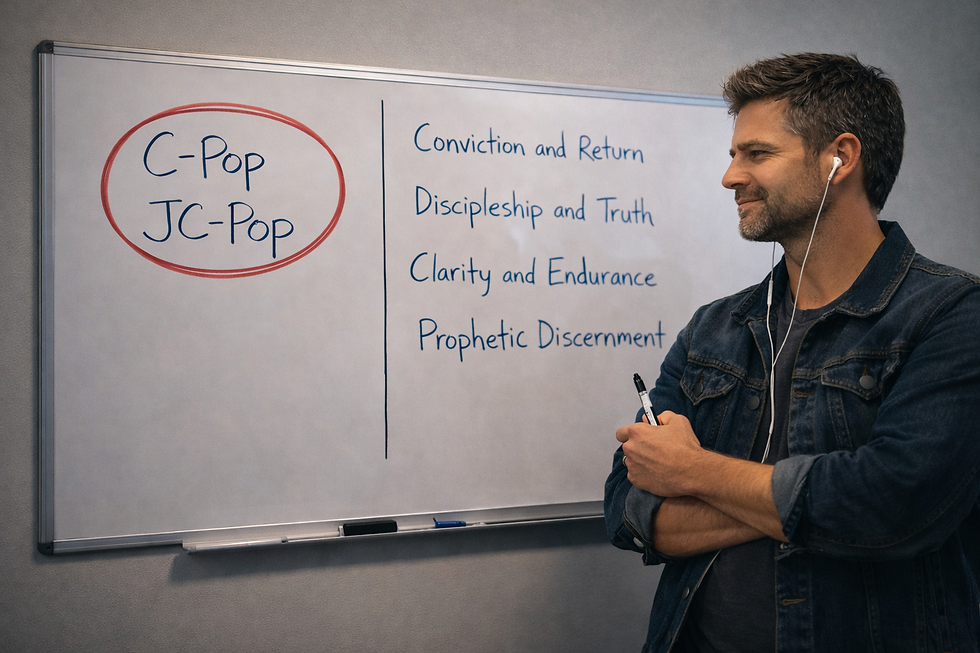
I did not intend to create terminology. In fact, I hesitated. The Christian music landscape hardly needs additional labels. But naming what I was seeing helped clarify what had previously felt vague. That is how C-Pop and JC-Pop began to take shape — not as brands, but as descriptions of spiritual function.
C-Pop — Conviction and Realignment
The first stream reflects music that calls the believer back into alignment with Scripture. It is not primarily celebratory or atmospheric. Its purpose is formative. It invites examination. It restores clarity. It speaks gently but unmistakably to the conscience.
I have called this C-Pop — Conviction Pop — though conviction must be understood biblically. It is not emotional pressure or intensity. Scripture teaches that it is the Holy Spirit who convicts of sin, righteousness, and judgment (John 16:8). The Word itself discerns the thoughts and intentions of the heart (Hebrews 4:12). Music, when governed by Scripture, becomes a vessel through which that truth can reach the conscience clearly. The song does not produce conviction; the Spirit does. But the clarity of the message either cooperates with that work — or obscures it.
Throughout Scripture, music often accompanied moments of return and renewal. The Psalms include repentance, confession, surrender, and renewed trust (Psalm 51). Paul instructs believers to sing in ways that teach and admonish one another (Colossians 3:16), language that implies ongoing formation rather than mere inspiration.
C-Pop recovers this dimension intentionally. It is music anchored in Scripture and willing to contrast cultural narratives with biblical truth. It addresses repentance, obedience, surrender, holiness, faithfulness, and transformation without embarrassment or dilution. It recognises that drift rarely happens dramatically. It happens slowly, subtly, almost imperceptibly. Music shaped by Scripture can gently interrupt that drift and call the heart back.

Importantly, C-Pop does not reject contemporary musical language outright. It may inhabit modern production styles. It may utilise current forms. But its governing centre is doctrinal clarity. The melody serves the message. The emotional arc flows from revealed truth rather than replacing it.
In this way, C-Pop restores the inward work of music — the work of realignment under the authority of Scripture.
JC-Pop — Prophetic Awareness and Strengthened Allegiance
The second stream addresses a different, though closely related, need.
If C-Pop calls the wandering heart back, JC-Pop prepares the anchored heart to stand.
Scripture does not only call believers to personal devotion; it also warns that history moves toward intensified spiritual deception. Christ Himself cautioned that falsehood would arise with convincing power (Matthew 24:4–5). Paul wrote of strong delusion accompanying the rejection of truth (2 Thessalonians 2:9–12). The book of Revelation presents worship and allegiance as central themes in the final movements of history (Revelation 14:6–12).
JC-Pop — Jesus-Centered Prophetic Pop — emerges from taking those warnings seriously.
It does not speculate about headlines or promote fear. It does not sensationalise current events. Instead, it recognises that Scripture frames human history within a larger spiritual conflict — a contest between truth and counterfeit, between genuine worship and misplaced allegiance.
Where C-Pop focuses on personal realignment, JC-Pop addresses collective discernment. It names the reality of spiritual confusion. It acknowledges that counterfeit light can appear persuasive. It reminds believers to test what they encounter rather than absorb it uncritically (1 John 4:1). It strengthens awareness that worship is not merely expressive; it is declarative. It signals loyalty.
In a culture saturated with spectacle, emotional persuasion, and spiritually blended language, JC-Pop steadies the mind. It reinforces allegiance to Christ in the face of subtle pressure. It prepares believers not merely to feel inspired, but to remain faithful when conviction becomes costly.
Again, style is not the defining factor. Purpose is. JC-Pop may use contemporary soundscapes, but its aim remains clear: to interpret the times through Scripture and to fortify the believer’s loyalty to Christ above atmosphere, trend, or cultural drift.
Two Streams, One Recovery
Seen together, these two streams are not innovations so much as recoveries of biblical function.
C-Pop restores the corrective, Spirit-led work of music in personal discipleship.
JC-Pop restores the watchful, allegiance-strengthening role of music in an age of spiritual ambiguity.
Neither seeks to replace the broader Christian music landscape. Rather, they offer a lens through which purpose once again takes precedence over style. They remind us that music does not merely reflect belief; it reinforces it. And in a time when formation is often subtle and influence constant, intentionality is not optional.
What began as unease slowly clarified into this recognition: something essential had thinned, not because creativity increased, but because function became secondary. Naming that gap was not an act of criticism. It was an attempt to reconnect music with the seriousness Scripture has always assigned to it.
And once that reconnection became clear, the implications for the present moment could no longer be ignored.
Why This Matters in the Present Hour
Up to this point, everything we have discussed could still be framed as refinement rather than necessity. One could argue that this is simply a thoughtful attempt to clarify musical purpose. But when Scripture’s broader narrative is brought into view, the conversation becomes more serious.
The Bible does not present history as open-ended. It presents it as moving toward resolution. Christ spoke plainly about increasing deception, spiritual confusion, and the hardening of allegiance as the age progresses (Matthew 24:4–14). Paul warned of persuasive spiritual currents that would blur truth and error (2 Thessalonians 2:9–12). Revelation portrays a final conflict in which worship and loyalty stand at the centre of global tension (Revelation 13–14). None of these passages are dramatic embellishments. They are sober descriptions of trajectory.
When those descriptions are placed alongside the spiritual climate of our time, the parallels are difficult to ignore. We are witnessing not only cultural division, but spiritual differentiation. Language that once carried doctrinal clarity is increasingly reshaped by emotion and personal interpretation. Experience is often elevated above tested truth, and spiritual vocabulary is widely used yet rarely examined. This environment is not overtly hostile to faith; it is saturated with spiritual expression that feels persuasive and familiar and that is precisely the type of atmosphere Scripture cautions believers to navigate carefully.
The concern, then, is not whether contemporary music sounds modern. The concern is whether formation is being governed by truth or by emotional persuasion. Music shapes expectation. It shapes what feels reverent, what feels safe, and what feels spiritually authentic. Over time, repetition and atmosphere can normalise patterns of thought before those patterns are consciously evaluated. When doctrinal clarity becomes secondary to experiential intensity, allegiance can shift subtly, almost imperceptibly.
We find that Scripture repeatedly instructs believers to remain watchful and discerning as history advances (1 Thessalonians 5:6; 1 John 4:1). It warns that deception will not always appear aggressive; it will appear convincing. If that is true — and the biblical record insists that it is — then music cannot be treated as spiritually neutral. It participates in the formation of character whether we acknowledge it or not.
This is where the earlier discussion of C-Pop and JC-Pop moves from theory into urgency. If Christ’s return is nearer than many assume — and the convergence of biblical indicators suggests that we are no longer speaking in terms of distant decades but in terms of approaching years — then preparation must move beyond abstract belief. It must touch the mechanisms that shape allegiance. It must include the ways in which worship is formed and reinforced. This is not a call to anxiety. It is a call to seriousness.
The final crisis described in Revelation revolves around worship and loyalty. That reality alone should prompt careful reflection about what trains the heart in its understanding of worship. So, if music is one of the primary tools through which worship is expressed and internalised, then intentionality becomes an act of spiritual stewardship rather than preference.
C-Pop and JC-Pop are not reactions born of alarm. They are responses shaped by pattern recognition. When Scripture’s warnings are taken at face value, and when current spiritual trends are examined honestly, the need for clarity becomes evident. Music must cooperate with the Holy Spirit’s work of conviction and strengthen discernment in a time of spiritual ambiguity. It must prepare believers not merely to feel inspired, but to remain anchored when persuasion intensifies.
The nearness of Christ’s return does not require speculation to be taken seriously. Scripture describes the signs. History reflects increasing acceleration. The cultural and spiritual landscape reveals increasing convergence. While no date can or should be assigned, the trajectory itself calls for readiness and readiness is not cultivated accidentally. It is cultivated through truth embedded deeply enough to withstand pressure, through worship formed carefully rather than casually, and through allegiance strengthened long before it is tested publicly.
This is why the gap could not be ignored. Not because creativity is wrong, nor because past generations were flawless, but because the hour appears later than many are willing to admit. If worship sits at the centre of the final movements of history, then formation through music cannot remain undefined.
The aim, therefore, is not to withdraw in suspicion nor to imitate culture uncritically, but to move forward with clarity. To ensure that what shapes the heart cooperates with what Scripture reveals. To prepare quietly, steadily, and faithfully for a soon-returning King.
The Lord’s Harvest — Faithfulness in the Late Hour
By the time this manifesto took shape, I realised something important. What began as curiosity had slowly turned into responsibility, and responsibility had quietly become surrender. This was never about building a musical framework for its own sake. It was about responding to what Scripture consistently reveals and aligning with it as faithfully as possible.
The name Adonai Katsir is an English translation that represents — “The Lord’s Harvest” — which did not emerge as a creative concept or branding exercise but rather it emerged as a reminder. A reminder that history is not drifting aimlessly. It is shown in Scripture that consistently speaks of a harvest at the close of the age — a moment of culmination that belongs not to human effort, but to God Himself.

Christ described the harvest as urgent and plentiful, urging labourers into the field because the time was not indefinite (Matthew 9:37–38). Revelation portrays a final harvest at the close of history, when the Son of Man gathers what is fully ripe (Revelation 14:14–16). Even the prophets spoke of harvest as an appointed moment of separation, describing Babylon as a threshing floor “at the time of her harvest” (Jeremiah 51:33).
Taken together, these passages reveal something steady and sobering: harvest is purposeful and timed. It comes when ripeness has matured. The field does not remain forever in preparation, and it comes in due course when the growing season has finished.
That reality does not call for panic. It is a warning that calls for seriousness.
If Scripture presents history as moving toward culmination, and if the spiritual climate of our time reflects the patterns Christ and the apostles warned about, then formation cannot be left undefined. Worship cannot be shaped casually. What trains allegiance must be handled with care.
Adonai Katsir exists within that awareness. Not as a claim to gather the harvest — for that belongs to God alone — but as a small act of cooperation with what He has already revealed. If conviction is the work of the Holy Spirit (John 16:8), and discernment is strengthened through truth (1 John 4:1), then the music that shapes worship should support that work rather than compete with it.
If we are living nearer to the closing movements of history than previous generations realised — not through speculative timelines, but through the convergence of biblical signs — then preparation must move from abstraction to intention. It must touch what forms our understanding of God. It must touch what steadies allegiance in an age of persuasion. It must touch what shapes our worship. Scripture describes believers as those who remain watchful and sober as the day approaches (1 Thessalonians 5:6). It speaks of those who love and long for His appearing (2 Timothy 4:8). That posture is not anxious. It is anchored. It is not fearful. It is faithful.
And so, the resolve becomes clear: to pursue music that cooperates with the Spirit’s work of conviction, to strengthen discernment in a time of spiritual confusion, and to live as faithful believers who are preparing — not in alarm, but in expectation — for the glorious appearing of Jesus Christ.
Perhaps what some might call “manifesto madness” was never about creating something new at all. It was simply the natural result of asking honest questions and refusing to leave them unanswered. What began as curiosity became conviction, and that conviction grew into a desire to offer something constructive — music, commentary, discussion, study, and reflection — that points people back to Scripture in its fullness and back to the person of our loving Saviour, Jesus Christ.
If we are indeed living in the closing movements of history, then clarity is a gift, and truth is a protection. The aim has never been to elevate a platform, but to help lift the fog of confusion through the grace and power of God, so that seekers may see more clearly, stand more firmly, and worship more faithfully.
If you are looking for resources, conversation, or music shaped by that conviction, you are welcome to join us at adonaikatsir.com and may the God of Creation richly bless you as you continue your journey of faith and life — watching, learning, and preparing for the glorious appearing of Christ.


Comments